When you buy through our links, we may earn a commission. Products or services may be offered by an affiliated entity. Learn more.

Does a CPAP Machine Count as a Carry-On?

- CPAP machines are considered protected medical devices and don’t count toward your carry-on or checked baggage, as long as they’re packed in their own case.
- You can bring your CPAP on board and store it under the seat or in overhead bins, and many airlines allow in-flight use of FAA-approved machines with prior notification.
- It’s a good idea to contact your airline at least 48 hours before your flight to confirm policies and plan for power needs, such as using batteries if outlets aren’t available.
- Preparing your CPAP for travel — like keeping it charged and packed separately — can help ensure a smooth airport experience and uninterrupted sleep therapy.
If you use continuous positive airway pressure (CPAP) therapy to treat obstructive sleep apnea, you may have noticed a drop in your sleep quality on nights when you can’t use your machine.
To get the most out of your next holiday or work trip, you may be wondering if it’s possible to bring your CPAP device with you on a plane. Since CPAP machines are considered medical assistive devices, you have the right to fly with your CPAP equipment and use it on the plane if you need. That being said, there are certain considerations to take into account.
We’ll discuss everything you need to know when flying with your CPAP device, including tips for a smooth check-in process and advice on how to pack your equipment so it doesn’t count as a carry-on.

Exploring CPAP Machines — But Haven’t Been Tested Yet?
Start with our easy, at-home sleep test. It’s stress-free and effective. Get results within a few days.
Is a CPAP Considered a Carry-On?
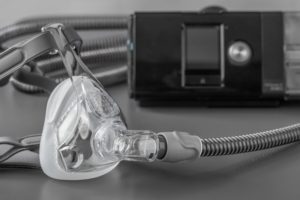
If your CPAP equipment is in its own carrying case separate from personal items, you can bring it on an airplane and stow it like a carry-on without it counting as your carry-on or toward your baggage count. Specifically, you can stow your CPAP for free under the seat in front of yours, in the overhead compartment, or in a designated area provided to you by airline staff.
CPAP equipment in its own case is allowed on a flight and doesn’t count toward your baggage limit because of an amendment to the Air Carrier Access Act of 1986. It’s called the Nondiscrimination on the Basis of Disability in Air Travel, and protects the use of medical assistive devices on both domestic and international flights. This law is enforced by the Federal Aviation Administration (FAA), which is part of the Department of Transportation (DOT).Airline staff may ask you to store your CPAP device in the cargo hold if storage on the plane is full. If you opt to store your CPAP as cargo, you won’t be charged for it. However, you also have the right to use your CPAP therapy onboard if needed.
Can You Use a CPAP Machine on a Plane?
You can use most CPAP machines on a plane. The law mandates that airlines allow people to use CPAP machines that are FAA-approved on airplanes that contain 19 or more seats. To find out if your CPAP machine is FAA-approved for in-flight use, check the label on the back or bottom of the machine. If you don’t see one, check the manufacturer’s website or reach out to the manufacturer. CPAP manufacturers can provide a compliance letter, which you can bring with you to the airport to demonstrate that your machine is FAA-approved to be used on a plane.
Even though most CPAP machines are FAA-approved to work in an airplane cabin, you still need to reach out to the airline at least 48 hours before your scheduled takeoff time to notify them that you’ll be using your CPAP device on the flight. Also, you may want to ask if the airline specifies a maximum size and weight for CPAP devices to ensure yours is allowed.
If you plan on using your machine on a flight, you should check in for your flight one hour earlier than required. This extra time may be needed for staff to find you a seat near a power supply if your machine isn’t battery-powered. Some airlines might not offer you a seat near a power supply, and may require you to bring batteries equipped to power your device for 150% of your estimated flight time.
On the plane, we recommend storing your CPAP bag under the seat in front of you (rather than in the overhead baggage bin) to make it easier to access. Also, ask the airline staff if your machine needs to be powered off during takeoff, and when you may begin to use it.

Tips for Flying With a CPAP Machine
The key to an efficient trip with your CPAP machine is to prepare in advance. You may also want to arrive at the airport a little earlier on the day of your flight. Here are some additional tips for flying with your machine.
Research the Airline Policy
U.S. airlines and international airlines flying in and out of the U.S. are bound by law to allow CPAP devices on planes. However, each airline may have their own additional specifications regarding CPAP equipment use during a flight. Call the airline at least 48 hours before your flight to notify them if you plan on using your CPAP device onboard, and to verify that your model is airplane-friendly.
Below, you can find policies for some popular airlines.
| Airline | Overview |
|---|---|
| American | American Airlines reserves the right to place your CPAP device in checked luggage if there is insufficient space in the cabin and you don’t need to use the device on your flight. While some seats have access to power outlets, American Airlines does not guarantee that you’ll be able to power your CPAP device on board. They recommend bringing fully-charged batteries and note that even if an outlet is available, it may require a DC power adapter. |
| Delta | Delta notes that their electrical outlets aren’t designed to power medical devices, so you cannot plug your CPAP machine in on a Delta flight. Instead, if you want to use a CPAP in-flight, Delta requires you to bring batteries that are charged and able to run for 150% of the estimated flight time, based on the manufacturer’s information about battery life. Delta also offers a direct phone line for accessibility assistance that you can call with questions about flying with medical devices, including CPAP machines. |
| Frontier | Frontier allows you to use a battery-powered CPAP machine on board during your flight as long as it has a sticker showing that it’s FAA-approved. Frontier does not allow passengers to plug CPAP machines into on-board electrical outlets. Like some other airlines, they ask that you bring charged CPAP batteries that can power your machine for 150% of your estimated flight time. |
| Jet Blue | JetBlue points out that while CPAP devices are allowed on flights without counting as a carry-on or personal bag, they must still meet the size and weight restrictions applied to carry-ons to be allowed. They also emphasize that having any personal items, like clothes or toiletries, in a bag with a CPAP will result in a fee being charged for the bag. JetBlue doesn’t allow passengers to use on-board electrical outlets to power CPAP machines or other medical devices. If you want to use your CPAP machine on a JetBlue flight, be sure it is battery-operated and you’ve brought fully charged batteries. |
| Southwest | Southwest may ask about the contents of your CPAP travel bag. Although Southwest has electricity-providing USB ports on some of their planes, they note that these cannot be used to power medical devices, including CPAP machines. If you want to use your CPAP machine in-flight, it must be battery-powered, and you must bring adequately charged batteries. |
| Spirit | Spirit verifies the content of medical assistance bags, and those that contain any personal items will result in a fee being charged. Electrical medical devices cannot be powered by electrical outlets on Spirit airplanes, so bring a battery-operated device and fully charged batteries capable of powering the machine for 150% of your estimated flight time if you plan to use your CPAP machine on a Spirit flight. |
| United | United allows the in-flight use of CPAP machines that feature a manufacturer’s label stating that they are FAA-approved. If you want to use a CPAP machine on a United flight, you must call United and let them know at least 48 hours before the planned flight time. While some United flights may have electrical outlets you can use with your CPAP machine, a power supply isn’t guaranteed. United recommends bringing batteries to power your device for the duration of your flight, your time in the airport, and an additional three hours. |
Pack Your CPAP Machine
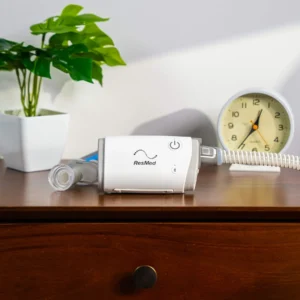
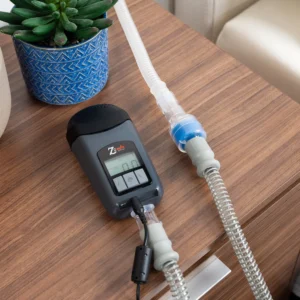
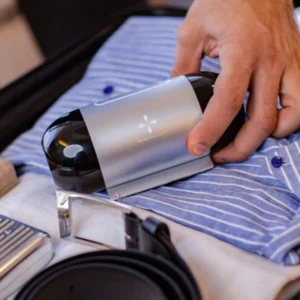
We suggest packing your CPAP device and accessories in a dedicated bag with a luggage tag. If you pack your CPAP in a bag with other items, airlines do not have to allow you to bring it on a flight without counting it as your carry-on or toward your baggage limit. If you travel frequently, consider investing in a travel CPAP machine that’s optimized for use away from home.
Depending on your destination and the length of your trip, you may also want to pack additional accessories, such as:
- Extra CPAP batteries that are fully charged
- CPAP wipes for on-the-go cleaning
- Replacement CPAP supplies including mask cushions, air filters, tubing, and headgear
- A waterless humidifier
- An extension cord or DC power converter
- A travel power adapter, if flying overseas
Make sure your CPAP machine’s water tub is empty before you get to the airport.
Bring Your Documentation
If you plan to use your CPAP machine on a flight, be prepared to show Transportation Security Administration (TSA) officers and airline staff the machine’s FAA approval sticker. You can also bring an FAA compliance letter from the CPAP manufacturer for additional documentation. While medical paperwork isn’t required to use a CPAP machine on a flight, some people like to bring their CPAP prescription or additional related medical paperwork for a feeling of security.
Many TSA agents are familiar with CPAP machines. However, if it makes you feel more comfortable, you can also request to talk to a Passenger Support Specialist (PSS) with training in medical devices. To speak with a PSS, you need to fill out a contact form online on the TSA website or call the TSA at least 72 hours before your planned flight time.
Using Your CPAP Machine on a Plane
To prepare to go through security with a CPAP machine, have your CPAP device in its own bag, separate from your other luggage and personal items, when you arrive at the airport. Also, bring a clear plastic bag to keep the CPAP machine clean when you remove it from its carrying case. The CPAP machine itself must be removed from its bag to go through the X-ray screening, but its accessories can remain in the CPAP bag.
Lithium or lithium ion batteries for your CPAP machine cannot travel in checked luggage because they pose a fire risk, so you’ll need to bring them on the plane with you.
Traveling Internationally With a CPAP
International flights to or from the United States are subject to the same U.S. laws that allow CPAP machines on board without counting toward your baggage limit. They also allow in-flight use of CPAP machines.
International airlines may have their own additional procedures regarding CPAP machines. Reach out to your airline well in advance to find out if there is anything you should do or bring to make traveling with your CPAP machine go smoothly. For example, some CPAP manufacturers recommend packing your CPAP prescription and a manufacturer’s FAA compliance letter when traveling internationally with a CPAP machine.
If you want to use your CPAP machine in-flight, ask your airline about power supply availability. You may need to bring fully charged batteries to power your CPAP machine while you fly. Also, research the electrical systems in the countries you’ll be visiting, to find out if you’ll need a travel plug adapter or voltage converter to be able to plug your CPAP machine in or charge your CPAP batteries at your destination.

Still have questions? Ask our community!
Join our Sleep Care Community — a trusted hub of sleep health professionals, product specialists, and people just like you. Whether you need expert sleep advice for your insomnia or you’re searching for the perfect mattress, we’ve got you covered. Get personalized guidance from the experts who know sleep best.
Jay Vera Summer is a writer, editor, and wellness coach. She holds a Bachelor's of Science in psychology and Master's degrees in both writing and public policy.
References14 Sources
Assistive Device – Stowage, Damage, and Delay | US Department of Transportation. Transportation.gov. Published 2024.
https://www.transportation.gov/resources/individuals/aviation-consumer-protection/assistive-device-guides/assistive-device-stowageMobility and medical devices − Travel information − American Airlines.
https://www.aa.com/i18n/travel-info/special-assistance/mobility-and-medical-devices.jspMedical Devices. Delta Airlines. Delta.com.
https://www.delta.com/us/en/accessible-travel-services/assistive-devices-medicationSpecial Services. Frontier Airlines. FlyFrontier.com. Published 2021.
https://www.flyfrontier.com/travel/travel-info/special-servicesMedical Devices. JetBlue. Jetblue.com. Published 2020.
https://www.jetblue.com/at-the-airport/accessibility-assistance/medical-devicesHelp Center | Southwest Airlines. Help Center | Southwest Airlines. Published 2026.
https://support.southwest.com/helpcenter/s/article/Assistive-and-other-medical-devicesAssistive Devices. Spirit Airlines Support. Spirit.com. Published 2026.
https://customersupport.spirit.com/en-us/category/article/KA-01315Portable Oxygen Concentrators (POC). Spirit Airlines Support. Spirit.com. Published 2026.
https://customersupport.spirit.com/en-us/category/article/KA-01165Traveling with oxygen. United.com. Published 2026.
https://www.united.com/en/us/fly/travel/accessibility-and-assistance/oxygen.html#ventilators-respirators-cpapPassenger Support | Transportation Security Administration. Tsa.gov. Published 2025.
https://www.tsa.gov/travel/tsa-cares/passenger-supportAm I allowed to carry my CPAP machine onboard the plane, do I have to remove it from my carry-on? | Transportation Security Administration. U.S. Department of Homeland Security Transportation Security Administration. Published 2025.
https://www.tsa.gov/travel/frequently-asked-questions/am-i-allowed-carry-my-cpap-machine-onboard-plane-do-i-have-removePackSafe – Portable Electronic Devices Containing Batteries | Federal Aviation Administration. Faa.gov. Published 2023.
https://www.faa.gov/hazmat/packsafe/portable-electronic-devices-with-batteriesNebulizers, CPAPs, BiPAPs, and APAPs | Transportation Security Administration. Tsa.gov. Published 2025.
https://www.tsa.gov/travel/security-screening/whatcanibring/items/nebulizers-cpaps-bipaps-and-apapsResmed. CPAP travel tips: Flying with your CPAP machine. Resmed. Published December 2, 2024.
https://www.resmed.com/en-us/sleep-health/blog/cpap-travel-tips-flying-with-your-cpap-machine/