When you buy through our links, we may earn a commission. Products or services may be offered by an affiliated entity. Learn more.

Can You Use Purified Water in a CPAP Machine?


- Distilled water is the best choice for CPAP humidifiers because it’s free of minerals and other impurities, reducing infection risk and maintaining optimal humidification performance.
- Tap water, spring water, or purified water can contain minerals that lead to buildup, scaling, and bacterial growth in your humidifier.
- Weekly cleaning of your CPAP humidifier tank with mild soap and water helps prevent mineral buildup and bacteria growth.
Not all water is the same when it comes to CPAP humidifiers. Using the right type of water in your CPAP humidifier plays an important role in comfort, cleanliness, and long-term machine performance.
Though purified water has been filtered to remove chemicals, it may still contain some mineral content. Some brands employ a reverse osmosis process, which removes impurities and microbes by forcing water through a semipermeable membrane. It’s then often remineralized, which is good for the human body but not your CPAP humidifier.
Below, we’ll explain why distilled water is recommended — and what to do if it isn’t available — to help you protect your equipment and get the most out of your CPAP therapy.

Exploring CPAP Machines — But Haven’t Been Tested for Sleep Apnea Yet?
Start with our easy, at-home sleep test. It’s stress-free and effective. Get results within a few days.
Why You Should Use Distilled Water in a CPAP Machine
Distilled water is the best choice for CPAP humidifiers because it’s pure water that’s free of minerals and bacteria, which reduces infection risk. Considered the purest form of bottled water, it’s produced by boiling water and then condensing the vapor back into liquid form.
Hospitals, labs, and factories often use distilled water instead of tap water because it prevents limescale buildup on devices. And using the wrong type of water in your CPAP humidifier can cause mineral buildup, scaling, or bacterial growth. It may also irritate your airways or cause your machine or its components to break down.
Can You Use Tap Water in a CPAP Machine?
While tap water is readily accessible and may be tempting to use in your CPAP humidifier, it can contain mineral deposits and other chemicals that may damage your machine or result in potentially harmful bacterial growth.
Tap water can come from a well or a municipal water supply. Though your tap water may be perfectly fine to drink, it may contain minerals that can cause buildup or scaling in your CPAP machine. Tap water may also contain additives like chlorine or fluoride that can harm your machine.
While you can boil water to kill bacteria, it will still contain any mineral content that was there prior to boiling.
Can You Use Bottled Water in a CPAP Machine?
You can use bottled water in your CPAP humidifier if it’s distilled water. Most bottled water used for drinking is purified or spring water. These don’t contain bacteria, but they may have minerals like calcium and magnesium that can leave residue in your humidifier and may cause it to wear out quicker than expected. Bottled water may also include:
- Spring water: Generally rich in mineral content, spring water comes from aquifers and is naturally filtered underground before it reaches an above-ground spring. Artesian water is similar to spring water, but it comes from an artesian well that taps an aquifer. Spring water may be refreshing to drink, but when you run it through your humidifier, the minerals can cause the machine’s components to break down.
- Mineral water: Mineral water sold in the U.S. must come from an underground water source and needs to contain a minimum amount of total dissolved solids to be branded as such.
Can I Use CPAP Without Water?
You can use a CPAP machine without water, but it may be less comfortable for some people. The water in a CPAP humidifier is used to add moisture to the air you breathe, which can help reduce side effects like dry mouth, nasal congestion, and throat irritation. If you choose not to use water, your CPAP will still deliver pressurized air, but the airflow will be dry. Using a CPAP without humidification may also increase risk of upper respiratory infections.
Some people temporarily use CPAP without water when distilled water isn’t available, such as while traveling or during a supply shortage. In these situations, many users turn off the humidifier feature or remove the water chamber entirely. Others may use a heat and moisture exchanger (HME), which captures moisture from exhaled air and helps humidify incoming air without the need for water.

How to Clean Your CPAP Humidifier Chamber
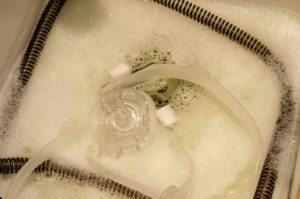
Regularly cleaning your CPAP — including the water tank — is incredibly important, as it helps prevent mineral buildup, bacteria growth, and unpleasant odors. Most manufacturers recommend cleaning the water chamber at least once a week, or more often if you notice residue or discoloration.
To clean your CPAP humidifier chamber, follow these steps:
- Start by unplugging your machine and removing the water chamber. Empty any remaining water.
- Soak the tank in warm water and a mild, fragrance-free dish soap.
- Gently scrub the inside with your hands or a soft brush, paying attention to corners where residue can collect.
- Rinse the tank thoroughly with clean water to remove all soap.
- Allow the water chamber to air dry completely on a clean surface before reinserting it into your CPAP machine.
Avoid using harsh chemicals, alcohol, bleach, or abrasive cleaners, as these can damage the tank and leave behind harmful residues. If mineral deposits develop, some manufacturers allow occasional soaking in a solution of water and white vinegar, followed by thorough rinsing. Always check your CPAP machine’s manual for specific cleaning instructions to ensure you don’t void the warranty or damage the equipment.
Tips for Traveling With CPAP Distilled Water
Traveling with a CPAP machine can make accessing distilled water more challenging, but a little planning can help keep your therapy comfortable.
If you’re flying, consider purchasing distilled water at your destination rather than packing it, since liquids in carry-on luggage are restricted. TSA allows travelers to carry 3.4 ounces distilled water for medical devices like CPAP machines, though you must declare it at security.
You may also want to consider packing distilled water in your checked luggage.
If distilled water isn’t available, you can temporarily use CPAP without humidification or turn off the humidifier until you’re able to find distilled water again. Heat and moisture exchangers (HMEs) can also be a convenient alternative, as they provide humidity without the need for water.
When traveling internationally or to remote locations, it may help to research availability ahead of time or plan for backup options. Always empty and dry your CPAP water tank before packing to prevent leaks and reduce the risk of bacterial growth during transit.
Best Place to Buy Distilled Water
Distilled water is easy to find. Most grocery stores, drug stores, and mini-markets carry distilled water. You can also buy it from online stores and CPAP suppliers. Some online retailers offer subscriptions so that you don’t have to worry about reordering or running out.

Still have questions? Ask our community!
Join our Sleep Care Community — a trusted hub of product specialists, sleep health professionals, and people just like you. Whether you’re searching for the perfect mattress or need expert sleep advice, we’ve got you covered. Get personalized guidance from the experts who know sleep best.
Austin Meadows is a professional writer, researcher, and sleep product tester with more than a decade of experience covering sleep science and sleep products. His work combines in-depth research with hands-on product testing to help readers better understand their sleep and make informed decisions about products that may improve it.
As a board-certified sleep medicine physician with over 20 years of clinical experience, Dr. Adavadkar is an expert in diagnosing and treating sleep disorders in both children and adults, as well as addressing sleep issues experienced by veterans. Dr. Adavadkar is a member of the Sleep Foundation Medical Advisory Board.
Learn more about our medical advisory boardReferences9 Sources
U.S. Environmental Protection Agency. (2005, September). Water health series: Bottled water basics.
https://www.epa.gov/ground-water-and-drinking-water/bottled-water-fact-sheetCenters for Disease Control and Prevention. (2020, August 4). A guide to drinking water treatment technologies for household use.
https://www.cdc.gov/healthywater/pdf/drinking/household_water_treatment.pdfAbd El-Salam, M.H. (2003). Membrane techniques: Applications of reverse osmosis. Encyclopedia of Food Sciences and Nutrition, 3833–3837.
https://www.sciencedirect.com/science/article/pii/B012227055X007628Raymond, L.W., Barkley, J.E., Langley, R., & Sautter, R. (2009). Prolonged respiratory illness after single overnight continuous positive airway pressure humidification: Endotoxin as the suspect. Southern Medical Journal, 102(12), 1260–1262.
https://pubmed.ncbi.nlm.nih.gov/20016436/U.S. Food and Drug Administration. (2022, April 22). Bottled water everywhere: Keeping it safe.
https://www.fda.gov/consumers/consumer-updates/bottled-water-everywhere-keeping-it-safeSanner BM, Fluerenbrock N, Kleiber-Imbeck A, Mueller JB, Zidek W. Effect of continuous positive airway pressure therapy on infectious complications in patients with obstructive sleep apnea syndrome. Respiration. 2001;68(5):483-487. doi:10.1159/000050555
https://pubmed.ncbi.nlm.nih.gov/11694810/Patel SR. Providing Cleaning Recommendations for Positive Airway Pressure Devices. Ann Am Thorac Soc. 2024;21(1):27-29. doi:10.1513/AnnalsATS.202308-683VP
https://pmc.ncbi.nlm.nih.gov/articles/PMC10867908/Schotland H. The Care and Cleaning of Your PAP Device. American Journal of Respiratory and Critical Care Medicine. 2020;201(11):P23-P24. doi:https://doi.org/10.1164/rccm.2020c3
https://www.atsjournals.org/doi/pdf/10.1164/rccm.2020C3Liquids, Aerosols, and Gels Rule. (n.d.). U.S. Transportation Safety Administration.
https://www.tsa.gov/travel/frequently-asked-questions/liquids-aerosols-and-gels-rule