When you buy through our links, we may earn a commission. Products or services may be offered by an affiliated entity. Learn more.

CPAP Cough


- Research has found that some people with OSA are at risk for developing a chronic cough.
- Increasing your CPAP machine’s humidity level adds moisture to your breathing passages, which can prevent dry airways and coughing.
- Keeping your CPAP equipment clean and functional can also help prevent CPAP cough and sinus infections.
- You should speak to a doctor if you have a cough that won’t go away, even after making the recommended adjustments.
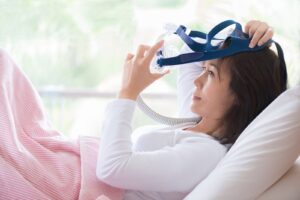
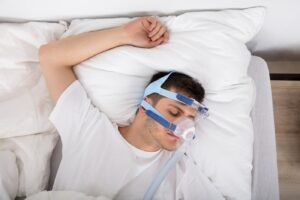
Continuous positive airway pressure (CPAP) therapy continues to be the most popular and effective treatment for obstructive sleep apnea (OSA) . However, adjusting to using a CPAP machine can take some time, and improper use or neglecting maintenance can lead to uncomfortable side effects such as CPAP cough.
Identifying the root cause of your CPAP-induced cough can be challenging, especially since it can mimic symptoms of a common cold or allergies. Luckily, fine-tuning your CPAP therapy can help address underlying issues and get rid of your CPAP cough. We’ll explore various potential causes of CPAP cough, explore troubleshooting strategies, and advise when professional medical evaluation becomes necessary.

Why Does My CPAP Make Me Cough?
There are a handful of reasons that your CPAP machine could be making you cough. To determine your cough’s cause, you may first want to consider whether your equipment fits correctly, is adjusted to the appropriate settings, and is clean and bacteria-free. Allergies and respiratory conditions could also be made worse by using the wrong equipment or not keeping your machine clean.
Dirty Air
Helping your CPAP cough may be as simple as adjusting your machine’s humidity settings or adding a humidifier if you don’t already have one. When dry air pushes through your breathing passages, it can irritate your throat and cause you to cough.
Air with a higher water percentage keeps your breathing passages moist and irritation-free. Using heated tubing can further enhance comfort by maintaining a consistent temperature and humidity level, which helps keep your airway moist and reduces irritation.
Dirty Equipment
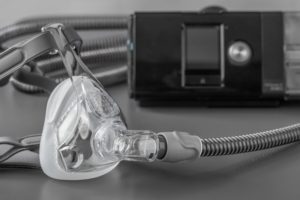
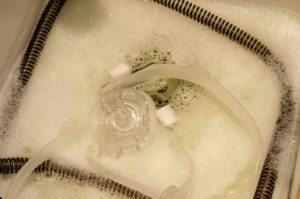
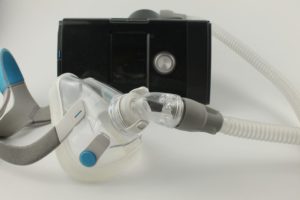
Warm, damp conditions inside CPAP masks and tubing create an ideal environment for bacteria, mold and viruses. Using dirty CPAP equipment can jump-start illness and make existing coughs worse. Regular, thorough cleaning of your CPAP mask and tubing is vital.
Don’t use tap water in your CPAP humidifier reservoir – it can lead to mineral build-up and scaling. Use only distilled water and make sure to clean the reservoir regularly and change water nightly to prevent microbial buildup.
Air Leaks or Poor Mask Fit
An ill-fitting mask or worn-out equipment can cause air leaks, leading to inadequate therapy and dry, irritated air. This may result in coughing, especially if the mask doesn’t align properly with your facial contours. Ensure your mask fits securely without causing discomfort, and consider replacing worn masks regularly.
For nasal masks or cushions, mouth breathing can also be a culprit. Using chinstraps or mouth tape can help maintain proper airflow and prevent dry mouth and throat irritation.
Allergies or Sensitivities
Most CPAP masks are made with silicone, which can be an irritant for some people to wear next to their skin. If you have silicone sensitivities, consider switching to masks made from hypoallergenic materials like foam or nasal cushions. Mask liners are an easy solution for those who aren’t allergic but don’t like the feeling of silicone against their skin.
Additionally, the products you use to clean your equipment matter. There are CPAP-specific cleaning products that can actually be dangerous to your health . In most cases, you should clean your mask and tube using mild, fragrance-free soap. Avoid sanitizing products and household cleaners.
Underlying Respiratory Conditions
Chronic coughing may come from an issue other than your CPAP machine. If you’ve checked your mask’s fit, cleaned your equipment, adjusted your humidifier, and looked for allergens, but your cough still won’t go away, it might be time to speak to your physician about a potential respiratory condition.

How to Stop CPAP Cough
Stopping a CPAP cough may be as simple as increasing humidity levels. Heated tubing and integrated humidifiers keep air at a consistent temperature and humidity that’s easier on your breathing passages.
Ensuring that your mask fits properly can also help because leaks can lead to dry mouth and coughing. If you use a nasal cushion but normally breathe through your mouth, you may need to switch to a full-face mask or use a chinstrap to prevent mouth breathing. If your mask is too old it can also start to leak, make sure that you’re on a regular CPAP mask replacement schedule to get the best possible fit.
Regular CPAP equipment cleaning can also help stop CPAP cough. Masks, tubing, and water reservoirs should get washed with mild soap and water on at least a weekly basis, but daily cleaning is better. Using your machine while it’s dirty can cause infections, viruses, and chronic coughing.
When to See a Doctor
If you have serious symptoms like fever, shortness of breath, or uncontrollable coughing, it’s time to speak to your physician. You may also want to see a doctor if you have a long-term mild cough but you’ve already taken steps to make sure that your mask fits properly, your humidity level is appropriate, and your CPAP equipment is clean.
Frequently Asked Questions
Should I use CPAP with a cough?
Seek medical attention if you experience symptoms such as fever, shortness of breath, or uncontrollable coughing. Persistent, long-term mild coughs despite adjustments should also prompt a consultation, especially if associated with other respiratory symptoms.
In some cases, the CPAP’s pressurized air can help clear your breathing passages and decrease coughing. If you can’t tolerate wearing your CPAP mask while you’re sick, you should speak with your physician.
While it’s always important to clean your CPAP equipment, it’s especially critical to prevent bacteria from developing when you have a cough or cold. Use mild soap and water and follow a regular cleaning schedule.
Can sleep apnea cause coughing?
Sleep apnea doesn’t necessarily cause coughing, but chronic coughs often accompany OSA. People with sleep apnea regularly stop breathing while they sleep, and some make gasping, choking, or coughing sounds.
These one-off sounds are different from chronic coughs, which some researchers say could be caused by sleep apnea
. However, studies haven’t been able to pinpoint a reason why OSA may cause coughing, just that they’re related. The same researchers say that using a CPAP machine can decrease instances of chronic coughing.
Can CPAP cause a sinus infection?
CPAP machine use can be a factor in developing sinus infections and other upper respiratory infections
. Humidifiers are helpful for keeping air moist and comfortable to breathe, but warm moist air can also lead to congestion.
However, a CPAP without a humidifier can be uncomfortable too. Dry air can cause nose bleeds and crusting. If you’re having issues finding the right humidity level, speak with your physician.

Still have questions? Ask our community!
Join our Sleep Care Community — a trusted hub of sleep health professionals, product specialists, and people just like you. Whether you need expert sleep advice for your insomnia or you’re searching for the perfect mattress, we’ve got you covered. Get personalized guidance from the experts who know sleep best.
Eric Suni has over a decade of experience as a science writer and was previously an information specialist for the National Cancer Institute.
Dr. Lulu Guo is a graduate of the prestigious Medical Scholars program at Michigan State University and was admitted into medical school at the age of seventeen after completing undergraduate studies in two years. She is double board-certified in Family and Sleep Medicine.
Learn more about our medical advisory boardReferences4 Sources
Cao MT, Sternbach JM, Guilleminault C. Continuous positive airway pressure therapy in obstuctive sleep apnea: benefits and alternatives. Expert Rev Respir Med. 2017;11(4):259-272. doi:10.1080/17476348.2017.1305893
https://pubmed.ncbi.nlm.nih.gov/28287009/Food and Drug Administration. (2024). Do You Need a Device That Claims to Clean a CPAP Machine?
https://www.fda.gov/consumers/consumer-updates/do-you-need-device-claims-clean-cpap-machineChan, K., Ing, A., Birring, S.B. (2015). Cough in obstructive sleep apnoea. Pulmonary Pharmacology & Therapeutics, 35. 129-131.
https://www.sciencedirect.com/science/article/abs/pii/S1094553915000656Patil, S. P., Ayappa, I. A., Caples, S. M., Kimoff, R. J., Patel, S. R., & Harrod, C. G. (2019). Treatment of Adult Obstructive Sleep Apnea with Positive Airway Pressure: An American Academy of Sleep Medicine Clinical Practice Guideline. Journal of clinical sleep medicine : JCSM : official publication of the American Academy of Sleep Medicine, 15(2), 335–343.
https://pmc.ncbi.nlm.nih.gov/articles/PMC6374094/