When you buy through our links, we may earn a commission. Products or services may be offered by an affiliated entity. Learn more.

Exercise and Sleep


- Regular exercise can help many people fall asleep faster, spend less time awake during the night, and improve overall sleep quality.
- Sleep and exercise influence each other: Physical activity can support better sleep, while poor sleep may reduce energy and motivation to exercise the next day.
- Moderate to vigorous exercise can benefit sleep, but very intense workouts close to bedtime may make it harder for some people to wind down.
- Evening exercise isn’t automatically bad for sleep, and the best workout time depends on your schedule, exercise intensity, and how your body responds.
Studies have found that proper exercise can alleviate sleep-related problems and help you get an adequate amount of rest. Recent research also suggests insufficient or poor-quality sleep can lead to lower levels of physical activity the following day.
For these reasons, experts today believe sleep and exercise have a bidirectional relationship. Optimizing your exercise routine can potentially help you sleep better, and getting an adequate amount of sleep may promote healthier physical activity levels during the day.
Looking to improve your sleep? Try upgrading your mattress.
Does Exercise Help You Sleep?
There are many benefits to exercising regularly , including a lower risk of diseases like cancer and diabetes, improved physical function, and a higher quality of life. Exercising can also benefit certain groups. For example, pregnant people who engage in routine physical activity are less likely to gain an excessive amount of weight or experience postpartum depression, and older adults who exercise are at lower risk of being injured during a fall.
Exercising also improves sleep for many people. Specifically, moderate to vigorous exercise can increase sleep quality for adults by reducing sleep onset – or the time it takes to fall asleep – and decrease the amount of time they lie awake in bed during the night. Additionally, physical activity can help alleviate daytime sleepiness and, for some people, reduce the need for sleep medications.
Exercise can also improve sleep in indirect ways. For instance, moderate to vigorous physical activity can decrease the risk of excessive weight gain, which in turn makes that person less likely to experience symptoms of obstructive sleep apnea (OSA). Roughly 60% of moderate to severe OSA cases have been attributed to obesity, though the relationship between weight and sleep apnea is complex.
Many studies and surveys have focused on the effects of exercise for people in various demographic groups. One study profiled college students during their examination periods and found that exercise and physical activity can reduce test-related stress. Another study noted that sleep and exercise are dynamically related for community-dwelling older adults. Additionally, a third study found that regular, mostly aerobic exercise reduced symptoms for people with OSA , even if they did not lose any weight in the process.
Compared to exercise, jobs involving manual labor may not provide the same relief for sleep problems. This may be because many laborious jobs often lead to musculoskeletal aches and pains that can negatively impact sleep. Moreover, manual labor involving long working hours can increase an employee’s risk for stress and fatigue .
Is Working Out Before Bed Bad?
The question of whether exercise in the hours before bedtime contributes to poor-quality sleep has been debated over time. Traditional sleep hygiene dictates that intensive exercise during the three-hour period leading up to sleep can negatively impact sleep because it can increase your heart rate, body temperature, and adrenaline levels. On the other hand, some studies have noted exercising before bed may not produce any negative effects.
The Best Times to Exercise for Healthy Sleep
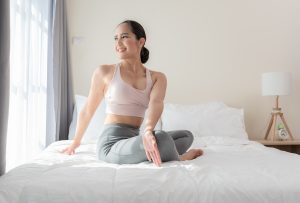
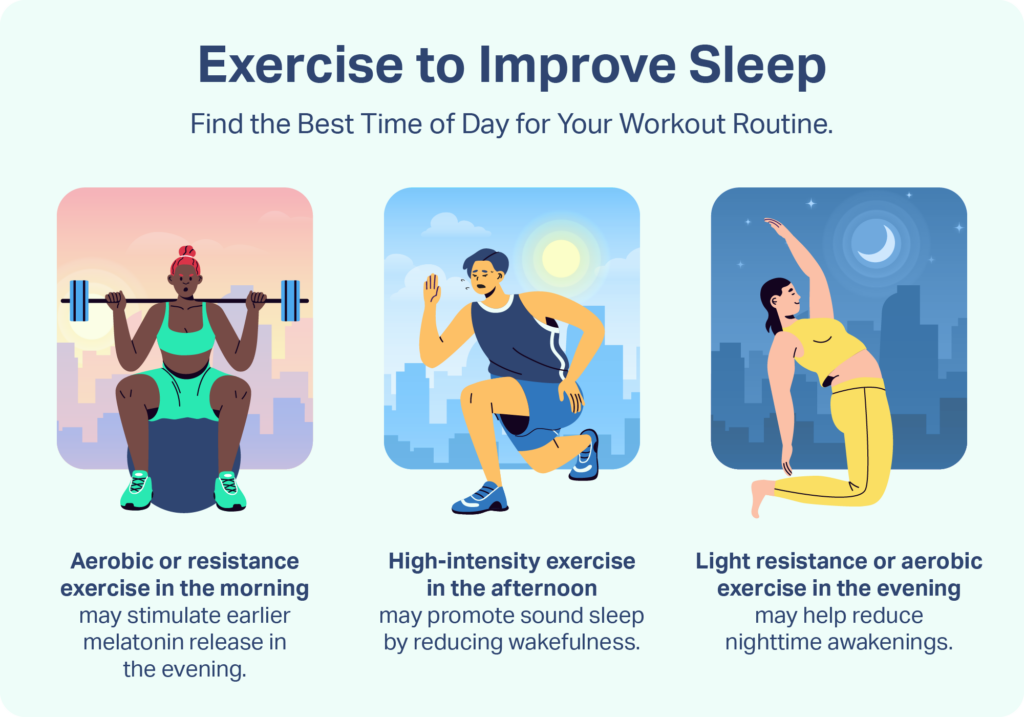
Survey results among people who exercise late at night have been variable, so you should base your exercise times and intensity on what best suits your sleep schedule. Certain exercises may be more beneficial for sleep than others. These include yoga, light stretching, and breathing exercises.
One survey found that the majority of people who exercise at 8 p.m. or later fall asleep quickly, experience an adequate amount of deep sleep, and wake up feeling well rested. Those who exercise between 4 p.m. and 8 p.m. reported similar percentages for these categories, suggesting late-night exercise may actually benefit some people.
Other studies have yielded similar results. In one, people who exercised in the evening experienced more slow-wave sleep and increased latency for rapid eye movement sleep compared to the control group, as well as less stage 1 (or light) sleep.
However, researchers also noted that a higher core temperature – which can occur after intensive workouts – was associated with lower sleep efficiency and more time awake after sleep onset. So while exercising before bedtime may not be inherently harmful, vigorous workouts in the hour leading up to bed can affect sleep efficiency and total sleep time.

How Does Sleep Impact Exercise?
The role sleep plays in physical activity levels has not been studied as thoroughly, and much of the research has focused on differences in physical activity between people with sleep disorders and people with healthier sleep.
However, most of these studies have concluded that those who experience poor sleep are less active than those with healthy sleep cycles. In particular, people with certain sleep disorders are not as likely to exercise during the day. Adults with insomnia tend to be less active than those without insomnia. The same is true for people with OSA and other types of sleep-disordered breathing.
Some studies have noted that nightly shifts in sleep quality, latency, and efficiency can be used to predict physical activity levels. For example, one study found that a 30-minute increase in sleep onset was associated with a one-minute decrease in exercise duration the next day.
A person’s preference for morning or evening activity may also play a role. People who are early risers or “morning people” are more likely to engage in physical activity than those who sleep in or are more active in the evening. In fact, some studies have suggested that exercise can possibly alter one’s diurnal preference over time, and may even shift their circadian rhythms.
Although many studies to date have established a relationship between high-quality sleep and healthy physical activity levels, current research has not conclusively proven that better sleep leads to an increase in physical activity levels.
While specific research varies, health professionals agree that a good night’s sleep can help you feel well rested and more motivated to exercise the following day. However, healthy sleep alone may not be enough to spontaneously change how you engage in physical activity.
Frequently Asked Questions
Is it OK to stretch before bed?
Yes, it’s generally fine to stretch before bed. While the American Academy of Sleep Medicine (AASM) advises that people with insomnia avoid strenuous exercise before sleep, there’s little evidence that moderate physical activity near bedtime has a negative impact
.
Gentle exercises like yoga and tai chi may even improve the quality of sleep
, though evidence that stretching improves sleep disorders like insomnia is limited
.
Will I gain weight if I sleep after exercise?
Fatigue after exercise is common, and while its causes aren’t fully understood
, there’s no evidence that going to sleep after exercising causes you to gain weight.
Rather, research suggests that getting too little sleep may contribute to weight gain. When you get insufficient sleep, the body’s level of the hunger hormone ghrelin rises while its level of leptin, which signals fullness, goes down. As a result, you may feel hungrier than when you get enough sleep.
Does exercise help sleep apnea?
Exercise may help improve sleep apnea, though the relationship is complicated and physical activity isn’t a cure or even a standalone treatment. The National Institutes of Health (NIH) lists regular physical activity as a healthy lifestyle habit that can help manage sleep apnea
. Regular exercise can also help people maintain a healthy weight, which may help improve sleep apnea that’s related to obesity.
Some research also suggests that regular exercise may help reduce severity of sleep apnea even without significant weight loss, though more research is needed to fully understand this relationship
.
Does exercise help insomnia?
Yes, exercise may help treat insomnia and improve overall sleep quality . The NIH notes that getting insufficient exercise may contribute to insomnia. However, existing studies suggest that too much strenuous exercise or vigorous exercise that ends within an hour of bedtime may disrupt sleep . Cognitive behavioral therapy for insomnia (CBT-I) remains the most strongly recommended treatment for the sleep disorder.

Still have questions? Ask our community!
Join our Sleep Care Community — a trusted hub of sleep health professionals, product specialists, and people just like you. Whether you need expert sleep advice for your insomnia or you’re searching for the perfect mattress, we’ve got you covered. Get personalized guidance from the experts who know sleep best.
Lauren is a Certified Sleep Science Coach with extensive experience researching and testing a wide variety of sleep products.
Dr. Abhinav Singh, board certified in Sleep Medicine and Internal Medicine, is the Medical Director of the Indiana Sleep Center, which is accredited by the American Academy of Sleep Medicine. He is also a Clinical Assistant Professor at Marian University College of Medicine in Indianapolis, where he developed and teaches a Sleep Medicine rotation.
Learn more about our medical advisory boardReferences19 Sources
U.S. Department of Health and Human Services. (2018). Physical Activity Guidelines for Americans (2nd edition).
https://health.gov/sites/default/files/2019-09/Physical_Activity_Guidelines_2nd_edition.pdfKline C. E. (2014). The bidirectional relationship between exercise and sleep: Implications for exercise adherence and sleep improvement. American journal of lifestyle medicine, 8(6), 375–379.
https://pubmed.ncbi.nlm.nih.gov/25729341/American Academy of Sleep Medicine. (2014). The International Classification of Sleep Disorders – Third Edition (ICSD-3). Darien, IL.
https://aasm.org/clinical-resources/international-classification-sleep-disorders/Wunsch, K., Kasten, N., & Fuchs, R. (2017). The effect of physical activity on sleep quality, well-being, and affect in academic stress periods. Nature and science of sleep, 9, 117–126.
https://pubmed.ncbi.nlm.nih.gov/28490911/Dzierzewski, J. M., Buman, M. P., Giacobbi, P. R., Jr, Roberts, B. L., Aiken-Morgan, A. T., Marsiske, M., & McCrae, C. S. (2014). Exercise and sleep in community-dwelling older adults: evidence for a reciprocal relationship. Journal of sleep research, 23(1), 61–68.
https://pubmed.ncbi.nlm.nih.gov/23980920/Van Offenwert, E., Vrijsen, B., Belge, C., Troosters, T., Buyse, B., & Testelmans, D. (2019) Physical activity and exercise in obstructive sleep apnea. Acta Clinica Belgica, 74(2), 92-101.
https://www.tandfonline.com/doi/full/10.1080/17843286.2018.1467587Martins, A. J., Vasconcelos, S. P., Skene, D. J., Lowden, A., & de Castro Moreno, C. R. (2016). Effects of physical activity at work and life-style on sleep in workers from an Amazonian Extractivist Reserve. Sleep science (Sao Paulo, Brazil), 9(4), 289–294.
https://pubmed.ncbi.nlm.nih.gov/28154743/Wong, K., Chan, A., & Ngan, S. C. (2019). The Effect of Long Working Hours and Overtime on Occupational Health: A Meta-Analysis of Evidence from 1998 to 2018. International journal of environmental research and public health, 16(12), 2102.
https://pubmed.ncbi.nlm.nih.gov/31200573/Myllymäki, T., Kyröläinen, H., Savolainen, K., Hokka, L., Jakonen, R., Juuti, T., Martinmäki, K., Kaartinen, J., Kinnunen, M. L., & Rusko, H. (2011). Effects of vigorous late-night exercise on sleep quality and cardiac autonomic activity. Journal of Sleep Research, 20(1 Pt 2), 146–153.
https://pubmed.ncbi.nlm.nih.gov/20673290/Youngstedt, S. D., & Kline, C. E. (2006). Epidemiology of exercise and sleep. Sleep and biological rhythms, 4(3), 215–221.
https://pubmed.ncbi.nlm.nih.gov/25374476/Stutz, J., Eiholzer, R., & Spengler, C. M. (2018). Effects of evening exercise on sleep in healthy participants: A systematic review and meta-analysis. Sports Medicine, 49(2), 269–287.
https://pubmed.ncbi.nlm.nih.gov/30374942/American Academy of Sleep Medicine. Research notes: 5 surprising facts about exercise and sleep. American Academy of Sleep Medicine. February 26th, 2013.
https://aasm.org/research-notes-5-surprising-facts-about-exercise-and-sleep/National Center for Complementary and Integrative Health. (2024, May). Sleep Disorders and Complementary Health Approaches.
https://www.nccih.nih.gov/health/sleep-disorders-and-complementary-health-approachesMohammad A, Elham H, Andreas K. A scoping review of the effect of chronic stretch training on sleep quality in people with sleep disorders. Eur J Appl Physiol. 2024;124(9):2533-2545. doi:10.1007/s00421-024-05541-z
https://link.springer.com/article/10.1007/s00421-024-05541-zTornero-Aguilera, J. F., Jimenez-Morcillo, J., Rubio-Zarapuz, A., & Clemente-Suárez, V. J. (2022). Central and peripheral fatigue in physical exercise explained: A narrative review. International Journal of Environmental Research and Public Health, 19(7), 3909.
https://pubmed.ncbi.nlm.nih.gov/35409591/National Heart, Lung, and Blood Institute. (2023). Sleep Apnea: Treatment.
https://www.nhlbi.nih.gov/health/sleep-apnea/treatmentPeng, J., Yuan, Y., Zhao, Y., & Ren, H. (2022). Effects of Exercise on Patients with Obstructive Sleep Apnea: A Systematic Review and Meta-Analysis. International journal of environmental research and public health, 19(17), 10845.
https://pubmed.ncbi.nlm.nih.gov/36078558/Alnawwar MA, Alraddadi MI, Algethmi RA, Salem GA, Salem MA, Alharbi AA. The Effect of Physical Activity on Sleep Quality and Sleep Disorder: A Systematic Review. Cureus. 2023 Aug 16;15(8):e43595. doi: 10.7759/cureus.43595. PMID: 37719583; PMCID: PMC10503965.
https://pubmed.ncbi.nlm.nih.gov/37719583/Stutz, J., Eiholzer, R., & Spengler, C. M. (2019). Effects of Evening Exercise on Sleep in Healthy Participants: A Systematic Review and Meta-Analysis. Sports medicine (Auckland, N.Z.), 49(2), 269–287.
http://link.springer.com/10.1007/s40279-018-1015-0
Learn More About Physical Activity and Sleep