When you buy through our links, we may earn a commission. Products or services may be offered by an affiliated entity. Learn more.

Lucid Dreaming


- Lucid dreaming occurs during a period of REM sleep when a sleeper realizes they’re asleep and dreaming. Often, they find that they can control the content of their dream.
- There are multiple evidence-backed methods to induce lucid dreams, including cognitive techniques, sleep schedule adjustments, external stimulation, and dietary supplements.
- Early research suggests that lucid dreaming may have benefits on mood, learning, and nightmare reduction, but it carries several risks as well.
Have you ever been asleep and realized you were dreaming? That’s lucid dreaming. Many people are fascinated by the phenomenon, as it often allows them to control what happens in their dreams. For example, they may choose to fly over canyons and mountains, explore imaginary worlds, or spend time with far-away loved ones. But it’s not without risk.
In this article, we’ll give you a quick primer on lucid dreaming, and then explore multiple expert-vetted methods to induce your own lucid dreams. We’ll also detail the benefits and risks of lucid dreaming and explain how to wake up from a lucid dream.
What Is Lucid Dreaming?
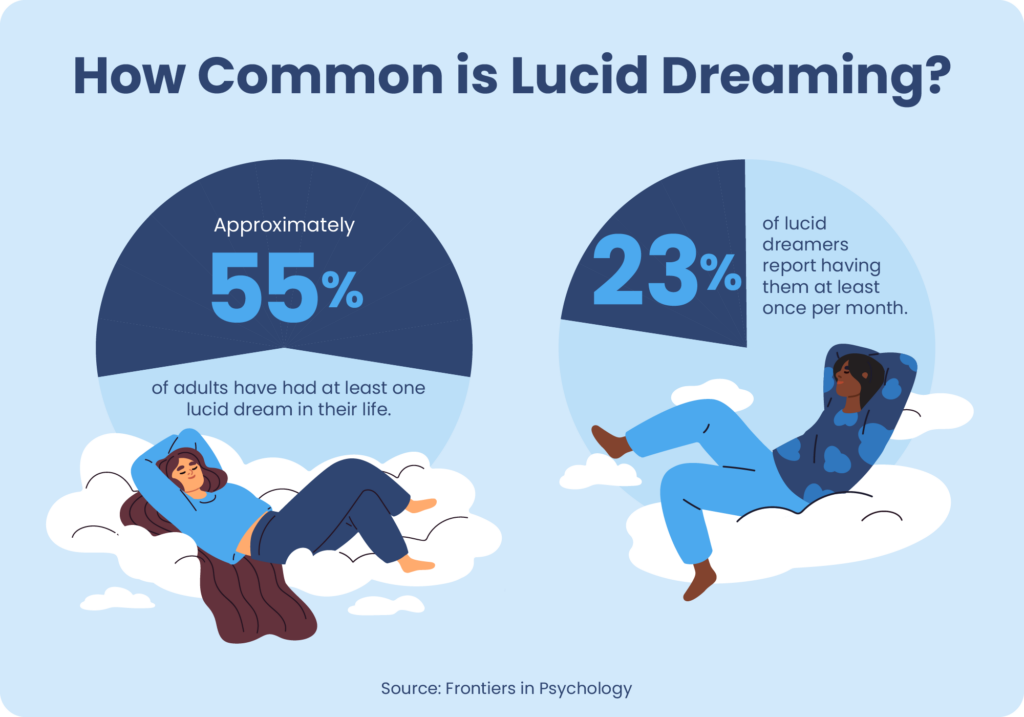
Lucid dreaming is a phenomenon in which a sleeper becomes aware that they’re dreaming while they’re still asleep. About 55% of people have experienced lucid dreaming . And in about one third of lucid dreams, the sleeper can influence or control what happens during the dream .
Lucid dreams are distinct from vivid dreams, which are dreams that a person can remember in great detail upon waking . While lucid dreams may be vivid, not all vivid dreams involve in-the-moment awareness that you’re dreaming.
Research indicates that lucid dreaming generally takes place during rapid eye movement (REM) sleep — the sleep stage in which most dreaming occurs. REM sleep takes place in increasingly long stretches over the course of a night, which means that lucid dreams are more likely to occur in the second half of a sleep .
Lucid Dreaming vs. Sleep Paralysis
Sleep paralysis is another dream state connected to REM sleep that’s characterized by high awareness. However, it has several key differences from lucid dreaming.
During sleep paralysis, the sleeper is awake and aware of their surroundings but is unable to move. This state is sometimes accompanied by hallucinations. As with lucid dreams, the sleeper often remembers the experience in vivid detail afterwards.
That said, while lucid dreaming is an active experience that allows the dreamer to interact with or guide the dream, sleep paralysis is largely passive. Also, while most people associate lucid dreaming with positive feelings, an estimated 80 to 90% of people who experience sleep paralysis associate it with fear.
Your best sleep starts with the right mattress.
Our expert testing team tried 300+ mattresses to find the top ones for every sleeping style. See our favorite mattresses of 2026 here.
- In-depth ratings and comparisons
- Regularly updated with new products and testing data
- Options for all types of sleepers

How to Have a Lucid Dream
Researchers have found multiple techniques that may help some people induce lucid dreaming.
Mnemonic Induction of Lucid Dreams (MILD)
Mnemonic induction of lucid dreams, also known as the MILD technique, appears to be one of the most effective methods for bringing on a lucid dream . The MILD technique involves creating an intention to recognize when you’re dreaming and carrying that intention into the dream state.
To use the MILD technique, follow these steps:
- Upon waking up in the middle of the night, try to recall what you’ve been dreaming about or the details of a previous dream you’d like to reenter.
- Identify signs from the dream that will help you recognize you’re dreaming if you fall back asleep and successfully reenter the dream.
- Repeat these words (or your own version of them): “When I begin dreaming, I will remember that I’m dreaming.”
- Continue recalling dream content and repeating that phrase until you fall asleep.
Even though the MILD technique tends to be more effective than many others, it leads to a lucid dream in fewer than one in five cases. Evidence suggests that the more quickly you fall back asleep after waking, the more likely you’ll be to have a lucid dream when using this technique.
Senses Initiated Lucid Dreams (SSILD)
The Senses Initiated Lucid Dream (SSILD) technique appears to have similar success rates to the MILD technique, although it’s newer and less studied. This method involves focusing on your senses, which could make you more likely to notice the transition into the dream world or might prime your mind and body for a lucid dream.
To practice the SSILD technique, cycle through the following steps multiple times. First, go through each step quickly for a few cycles. Then, cycle through while spending a few seconds on each step. Finally, do up to six slow cycles in which you spend 20 seconds in each step and, ideally, fall asleep.
- Vision: With your eyes closed, relaxed, and still, focus on what you see. It might be total darkness or colors, shapes, or images. The goal isn’t to see anything in particular but simply to notice what’s there.
- Hearing: Shift your focus to what you can hear. You might hear sounds made by your body, such as your heartbeat or breaths, or you might hear external sounds, such as crickets chirping or traffic noises. Listen without judging.
- Body sensations: Direct your attention to what your body is feeling. You might notice internal sensations, such as muscle fatigue or air traveling into your lungs. Or, you might notice external sensations, such as the warmth and weight of your bedding.
Wake Back to Bed (WBTB)
Wake Back to Bed (WBTB) is often used in combination with other techniques intended to induce lucid dreaming . In its most basic form, WBTB involves purposely waking up during the night, staying awake for a period of time, then returning to sleep . Ideally, the sleeper disrupts and later returns to REM sleep, setting the stage for a lucid dream .
To practice WBTB:
- Set an alarm for a point in the night in which you’re likely to be dreaming but will also have the capacity to fall back asleep. Aim to wake at least five hours after going to bed or longer.
- Stay awake for between 30 minutes and two hours. To boost your chances of having a lucid dream, use this time to practice other techniques, such as the MILD technique, the SSILD technique, or dream journaling.
- Go back to sleep. Some research suggests that an hour is the optimal time to wait before returning to sleep, while other research indicates you’re more likely to have a lucid dream if you fall asleep as soon as possible after completing a technique like MILD. Experiment with timing to figure out what works for you.
Reality Tests
Many studies have investigated whether or not the practice of regularly conducting “reality tests,” also called “reality checks,” can induce lucid dreams or increase their frequency. This approach is intended to help a person build a habit of assessing whether they’re awake or dreaming, thereby improving the likelihood that they’ll become aware of a dream state. However, there’s little evidence to support the efficacy of this technique, and users have complained that it can be difficult and burdensome.
Still, studies haven’t ruled out the possibility that reality tests might enhance other techniques, and it’s possible that studies haven’t required participants to use reality tests for long enough to make a difference. If you would like to try this technique, select one or more of the following reality tests to perform at least 10 times a day while you’re awake, as well as while you’re dreaming, if possible:
- Ask yourself “Am I dreaming?”
- Assess your surroundings for signs that you might be dreaming.
- Try breathing through your mouth with your lips pressed together. You’ll only be able to do so if you’re dreaming.
- Attempt to push your index finger through the palm of the opposite hand. If you can, you are dreaming.
Dream Journal
Some people who have lucid dreams swear by the technique of keeping a dream journal, which involves writing down your dreams in as much detail as possible as soon as you wake up. Some lucid dreamers say that keeping a dream journal trains them to recall their dreams, helps them notice “dream signs,” and facilitates reality checks.
While there’s little scientific evidence that dream journals help induce lucid dreams, dream journals do appear to improve dream recall, which may be useful if you practice the MILD technique. Studies have also found that some people have lucid dreams after using dream journals in combination with other techniques.
External Stimulation
A number of devices (like lucid dream masks) are marketed as being able to induce lucid dreams by providing various kinds of external stimulation . Many of these devices are designed to identify or predict when a sleeper has transitioned into REM sleep, often by monitoring brain waves or eye movement. When this happens, the devices administer sounds, vibrations, or blinking lights that are intended to serve as cues to dreamers, helping them realize they’re dreaming.
Some devices also provide transcranial alternating current stimulation (tACS), delivering electric currents through the scalp to the frontal cortex of the brain. This is intended to generate gamma activity in the brain, which studies have linked to lucid dreaming .
Limited evidence suggests that light cues, combined light and sound cues, and tACS may increase the likelihood of having a lucid dream . More research is needed to verify that external stimulation devices live up to their marketing claims.
Dietary Supplements
A number of studies indicate that a plant-derived drug called galantamine can effectively induce lucid dreams. In its prescription form, galantamine is used to treat Alzheimer’s disease, but it’s also available as a dietary supplement intended to boost memory and promote lucid dreams . Research also indicates that a supplement called Alpha-GPC, a form of the nutrient choline, may enhance the effectiveness of galantamine.
Talk to your doctor before taking any dietary supplements. Galantamine may pose risks for people with certain health conditions, including heart, kidney, or liver disease; asthma or any other lung disease; ulcers; seizures; or irregular heartbeat . Also, dietary supplements aren’t regulated like prescription drugs, and their contents may not always align with what’s written on their packaging.
Combine Techniques
A recent study found using a combination of techniques produced lucid dreams on 42% of the nights during the study period, which is the best rate of lucid dream induction on record. Based on these findings, some experts propose the following steps as the most effective way to induce a lucid dream:
- Take vitamin B6 before going to bed to boost your body’s choline levels.
- Set an alarm to wake you 5 hours after going to sleep.
- After you wake to your alarm, take a combination of galantamine and Alpha-GPC.
- Practice the MILD technique or the SSILD technique.
- Put on a device that provides light stimulation.
- Return to sleep as soon as possible.
Benefits of Lucid Dreaming
While research is still preliminary, some evidence suggests that lucid dreaming has benefits that last beyond one night of sleep.
- Reducing nightmares: Early evidence suggests that lucid dreaming may help to reduce recurring nightmares since the awareness offers the dreamer a chance to either confront the threat or guide the dream away from it .
- Managing anxiety and depression: While there’s some research indicating that therapeutic induced lucid dreaming can help treat anxiety and depression, the evidence is somewhat mixed, and this method hasn’t been found more effective than other types of therapy.
- Improving mood: While further research is needed, initial research shows a correlation between lucid dreaming and a positive waking mood .
- Facilitating problem solving and learning: Research has shown that people who were prompted to think about solving puzzles before normal sleep, without induced lucid dreaming, showed significant improvement when finding solutions . The same researchers suggest that two-way communication during lucid dreaming could help people find solutions to problems and learn skills even faster .

Is Lucid Dreaming Dangerous?
While many people view lucid dreams as pleasant and desirable, they can be negative experiences for some people. On occasion, they may even pose risks to physical and mental health.
- Sleep loss: Many methods of inducing lucid dreams require a person to wake in the night, which disrupts sleep . Additionally, some people report difficulty falling back asleep or poor sleep quality after failed attempts to induce lucid dreams. Sleep loss can have serious implications for a person’s health and wellbeing.
- Altered sleep architecture: Because the brain behaves differently during lucid dreaming than it does during non-lucid REM sleep, some experts have expressed concern that lucid dreaming might disrupt important processes that ordinarily occur during REM sleep.
- Sleep paralysis: Some people who induce lucid dreams experience sleep paralysis, an intrusion of REM sleep into waking that temporarily prevents a person from moving or speaking.
- Dysphoric dreams: Sometimes, failed attempts to induce a lucid dream can lead to nightmares. Moreover, while lucid dreams are usually positive experiences, people have reported lucid nightmares in which they’re aware they are dreaming but unable to escape terrifying or horrific dream content.
- Reality confusion: Some people experience “false awakenings” during lucid dreams that lead to confusion about whether they’re awake or asleep.
- Dissociative states: For some people, deliberately inducing lucid dreams can lead to mental states in which they have trouble integrating or controlling their emotions, sense of self, understanding of reality, and connection to their bodies . People with certain mental illnesses may be especially vulnerable to this effect.
Before attempting to induce a lucid dream, it’s important to consider these risks. If you have any concerns or you plan to use dietary supplements, make sure to discuss your plans with a doctor or mental health professional.
How to Wake Up From a Lucid Dream
Lucid dreams typically end on their own, but if you want to wake up from them intentionally, there are a few techniques that lucid dreamers commonly use. The most common is to consciously stop all engagement with the dream and wait for it to fade. Blinking rapidly in the dream, or shifting your attention to your physical body can help.
Be aware that waking from a lucid dream can sometimes lead to a “false awakening,” where you believe you have woken up but are, in fact, still in a dream.
Frequently Asked Questions
What does it mean to have lucid dreams?
If you have lucid dreams, you’re aware of the fact that you are asleep and dreaming. This state usually occurs in conjunction with REM sleep, and many people find that they can control what happens in their lucid dreams.
The content of a lucid dream may reflect your thoughts, emotions, memories, or experiences, much like other dreams, but there’s no scientific evidence that lucid dreams predict the future or carry hidden messages.
What does lucid dreaming feel like?
Most people who have lucid dreams describe them as pleasant or even blissful experiences, with some reporting soft vibrations or warmth as they enter. Many also say their senses are heightened, with sight, touch, and hearing feeling as intense as real life.
Can you get stuck in a lucid dream?
You cannot get stuck in a lucid dream. They occur with REM sleep, and REM sleep periods are finite by nature. That said, you may feel a sensation of being stuck.
How long do lucid dreams last?
Lucid dreams vary in length, but typically last from a few minutes to as long as 15 minutes. Some may last longer, but the duration is limited by the length of the REM sleep period.
Can lucid dreaming lead to sleep paralysis?
While lucid dreaming and sleep paralysis are two different conditions, preliminary research shows a connection between the two. More rigorous studies are needed to fully understand whether lucid dreaming can lead to sleep paralysis, but early evidence suggests it’s possible.
Medical Disclaimer: The content on this page should not be taken as medical advice or used as a recommendation for any specific treatment or medication. Always consult your doctor before taking a new medication or changing your current treatment.

Still have questions? Ask our community!
Join our Sleep Care Community — a trusted hub of product specialists, sleep health professionals, and people just like you. Whether you’re searching for the perfect mattress or need expert sleep advice, we’ve got you covered. Get personalized guidance from the experts who know sleep best.
Lucy Bryan is a writer and editor with more than a decade of experience in higher education. She holds a B.A. in journalism from the University of North Carolina at Chapel Hill and an M.F.A. in creative writing from Penn State University.
Dr. Abhinav Singh, board certified in Sleep Medicine and Internal Medicine, is the Medical Director of the Indiana Sleep Center, which is accredited by the American Academy of Sleep Medicine. He is also a Clinical Assistant Professor at Marian University College of Medicine in Indianapolis, where he developed and teaches a Sleep Medicine rotation.
Learn more about our medical advisory boardReferences20 Sources
Ableidinger, S., & Holzinger, B. (2023). Sleep paralysis and lucid dreaming-between waking and dreaming: A review about two extraordinary states. Journal of Clinical Medicine, 12(10), 3437.
https://pubmed.ncbi.nlm.nih.gov/37240545/Adventure-Heart D. J. (2020). Findings from the International Lucid Dream Induction Study. Frontiers in Psychology, 11, 1746.
https://pubmed.ncbi.nlm.nih.gov/32765385/Zak, R., & Karippot, A. (2023, October 18). Nightmare and nightmare disorder in adults. UpToDate.
https://www.uptodate.com/contents/nightmares-and-nightmare-disorder-in-adultsPatel, A. K., Reddy, V., Shumway, K. R., Araujo, J. F. (2024, January 26). Physiology, sleep stages. StatPearls.
https://www.ncbi.nlm.nih.gov/books/NBK526132/Tan, S., & Fan, J. (2023). A systematic review of new empirical data on lucid dream induction techniques. Journal of Sleep Research, 32(3), e13786.
https://pubmed.ncbi.nlm.nih.gov/36408823/Stumbrys, T., Erlacher, D., Schädlich, M., & Schredl, M. (2012). Induction of lucid dreams: A systematic review of evidence. Consciousness and Cognition, 21(3), 1456–1475.
https://pubmed.ncbi.nlm.nih.gov/22841958/Erlacher, D., & Stumbrys, T. (2020). Wake up, work on dreams, back to bed and lucid dream: A sleep laboratory study. Frontiers in Psychology, 11, 1383.
https://pubmed.ncbi.nlm.nih.gov/32670163Erlacher, D., Furrer, V., Ineichen, M., Braillard, J., & Schmid, D. (2022). Combining wake-up-back-to-bed with cognitive induction techniques: Does earlier sleep interruption reduce lucid dream induction rate?. Clocks & Sleep, 4(2), 230–239.
https://pubmed.ncbi.nlm.nih.gov/35645242Mota-Rolim, S. A., Pavlou, A., Nascimento, G. C., Fontenele-Araujo, J., & Ribeiro, S. (2019). Portable devices to induce lucid dreams-Are they reliable?. Frontiers in Neuroscience, 13, 428.
https://pubmed.ncbi.nlm.nih.gov/31133778Voss, U., Holzmann, R., Hobson, A., Paulus, W., Koppehele-Gossel, J., Klimke, A., & Nitsche, M. A. (2014). Induction of self awareness in dreams through frontal low current stimulation of gamma activity. Nature Neuroscience, 17(6), 810–812.
https://pubmed.ncbi.nlm.nih.gov/24816141/Voss, U., Holzmann, R., Tuin, I., & Hobson, J. A. (2009). Lucid dreaming: A state of consciousness with features of both waking and non-lucid dreaming. Sleep, 32(9), 1191–1200.
https://pubmed.ncbi.nlm.nih.gov/19750924/LaBerge, S., & Levitan, L. (1995). Validity established of DreamLight cues for eliciting lucid dreaming. Dreaming, 5, 3.
https://psycnet.apa.org/doiLanding?doi=10.1037%2Fh0094432Naguy A, Husain K, Alamiri B. Galantamine beyond Alzheimer’s disease-a fact or artefact?. CNS Spectr. 2022;27(3):268-271. doi:10.1017/S1092852920002229
https://pubmed.ncbi.nlm.nih.gov/33308343/MedlinePlus. Galantamine. U.S. National Library of Medicine. Updated March 15, 2020.
https://medlineplus.gov/druginfo/meds/a699058.htmlTzioridou S, Campillo-Ferrer T, Cañas-Martín J, et al. The clinical neuroscience of lucid dreaming. Neurosci Biobehav Rev. 2025;169:106011. doi:10.1016/j.neubiorev.2025.106011
https://www.sciencedirect.com/science/article/pii/S0149763425000119Stocks A, Carr M, Mallett R, et al. Dream lucidity is associated with positive waking mood. Conscious Cogn. 2020;83:102971. doi:10.1016/j.concog.2020.102971
https://pubmed.ncbi.nlm.nih.gov/32535498/Sanders KEG, Osburn S, Paller KA, Beeman M. Targeted Memory Reactivation During Sleep Improves Next-Day Problem Solving. Psychol Sci. 2019;30(11):1616-1624. doi:10.1177/0956797619873344
https://journals.sagepub.com/doi/10.1177/0956797619873344Stoughton J. Scientists break through the wall of sleep to the untapped world of dreams. U.S. National Science Foundation. Published February 18, 2021.
https://www.nsf.gov/science-matters/scientists-break-through-wall-sleep-untapped-world-dreamsMallett, R., Sowin, L., Raider, R., Konkoly, K. R., & Paller, K. A. (2022). Benefits and concerns of seeking and experiencing lucid dreams: Benefits are tied to successful induction and dream control. Sleep Advances: A Journal of the Sleep Research Society, 3(1).
https://pubmed.ncbi.nlm.nih.gov/37193400Loewenstein R. J. (2018). Dissociation debates: Everything you know is wrong. Dialogues in Clinical Neuroscience, 20(3), 229–242.
https://pubmed.ncbi.nlm.nih.gov/30581293