When you buy through our links, we may earn a commission. Products or services may be offered by an affiliated entity. Learn more.

Does Napping Impact Your Sleep at Night?


- Napping doesn’t always interfere with nighttime sleep, but the timing and length of a nap can make a difference.
- Short naps taken earlier in the day are less likely to disrupt sleep at night, while long or late-afternoon naps may make it harder to fall asleep at bedtime.
- People with insomnia or difficulty sleeping at night may be more sensitive to the effects of daytime naps.
- If naps are affecting nighttime sleep, limiting naps to 20 to 30 minutes and avoiding naps late in the day may help.
A brief nap can be refreshing and restorative, especially if you are sleep deprived, but longer naps late in the day can negatively impact your sleep quality and duration. A primary key to taking a successful nap comes down to timing. For most people, the ideal nap lasts 30 minutes. Studies have also shown the best time to take a nap is in the early afternoon, when most people experience a natural decline in energy and alertness.
Your best sleep starts with the right mattress.
Our expert testing team tried 300+ mattresses to find the top ones for every sleeping style. See our favorite mattresses of 2026 here.
- In-depth ratings and comparisons
- Regularly updated with new products and testing data
- Options for all types of sleepers

How Naps Affect Sleep
Research shows that afternoon naps – when timed correctly – do not negatively impact nighttime sleep. In multiple studies, people who took afternoon naps obtained as much or more sleep in a 24-hour period than those who didn’t nap.
In most cases, the benefits of afternoon naps far outweigh any of the drawbacks. However, if you nap too late in the afternoon, or for too long, you may experience difficulties falling and staying asleep during the night. This can occur because daytime napping reduces your sleep drive, your body’s need for sleep.
Because of this, most experts recommend avoiding naps after 3 p.m. to limit disruptions to your sleep schedule.
The Best Time to Nap
For people who maintain a traditional sleep-wake schedule, napping in the early afternoon (between 1 p.m. and 3 p.m.) is likely optimal. Many people naturally experience a period of decreased energy and alertness in the early afternoon, known as the “post-lunch dip” or “afternoon slump.” Napping during this time has been found to boost energy levels, increase alertness, improve mood, enhance memory and cognitive ability, and improve physical ability.
In general, experts recommend limiting your nap to at least eight hours before bedtime to avoid nighttime sleep problems.
How Long Should a Nap Be?
For most people, napping for 30 minutes or less will have the most beneficial effect. Shorter naps allow the body to get some light sleep without entering deep sleep. If you wake up during deep sleep, you may find yourself to be even groggier than you were before the nap.
In some cases, napping for 90 minutes can also provide substantial benefits. Napping for this length allows your body to cycle through the stages of sleep and avoids disrupting deep sleep.
How to Nap Without Regretting It
If you want to get the benefits of an afternoon nap without experiencing drowsiness when you wake up, try these tips.
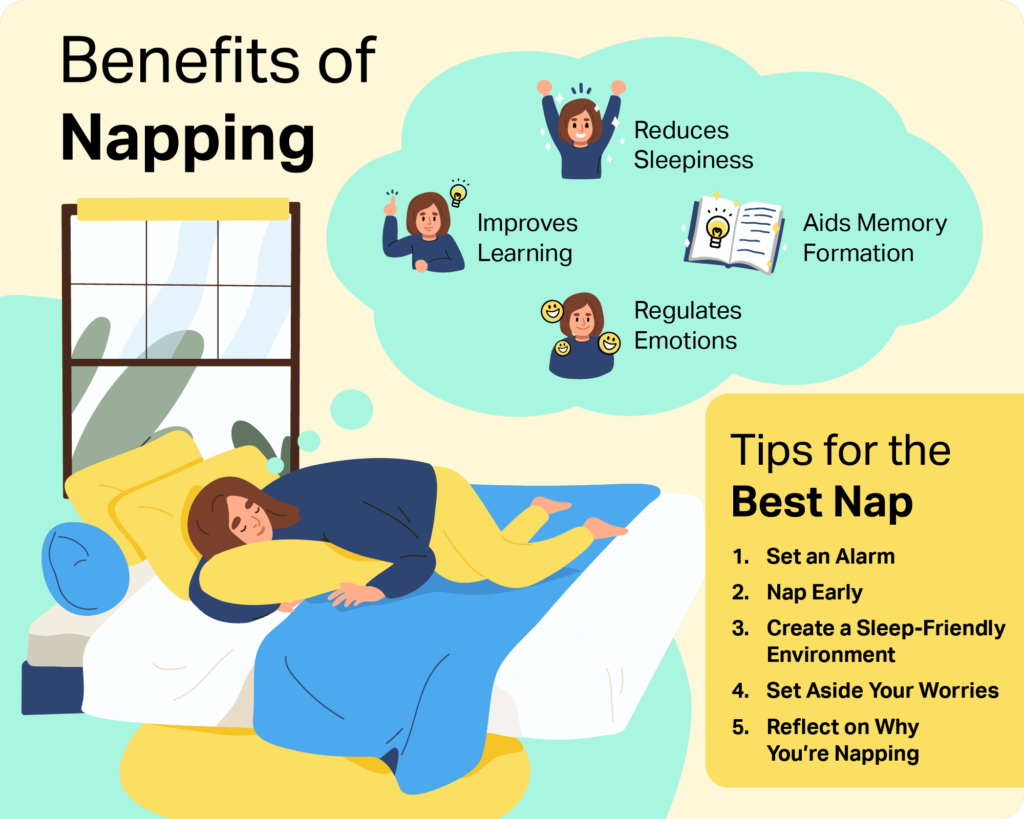
- Set an alarm. Shorter naps of 30 minutes or less are less likely to cause drowsiness upon awakening. Setting an alarm can help ensure you don’t nap longer than intended.
- Nap earlier than later. If possible, aim to take your nap in the early afternoon, rather than the late afternoon. Later naps could be more likely to negatively impact nighttime sleep.
- Block out distractions. Blocking out distractions, like noise and light, can help when you’re trying to sleep during the day. Consider using light-blocking curtains or an eye mask to block out light and earplugs or a white noise machine to block out sound
- Take a Coffee Nap. Having coffee before a short nap has been shown to help people feel more alert after a nap than just a nap alone.
If you find yourself frequently napping during the day, you may not be getting the recommended amount of sleep you need each night. If you still need naps despite getting adequate sleep, talk to your doctor to assess your sleep quality and rule out any potential sleep disorders.

Frequently Asked Questions
Do naps count towards sleep hours?
Naps can count toward your overall sleep hours, but when and how long you nap can impact your nighttime sleep. Experts recommend napping earlier in the day, otherwise it could be harder to fall asleep at night.
What is the difference between a nap and sleep?
A nap is a short doze that takes place outside of your usual sleep window. A short nap typically allows you to get a quick rest in which you enter just the light sleep stage and wake up refreshed. Sleep is when you allow your brain and body to rest for several consecutive hours, in which you cycle through different sleep stages including REM.
Do naps help with sleep debt?
Naps can help with “sleep debt,” in the sense that they can help you feel refreshed after having a poor night’s sleep. However, naps aren’t an adequate replacement for sleep, because they don’t give your body the same restorative rest that a full sleep does.
Naps generally aren’t long enough to get you through the different sleep stages including REM, which are important for brain development.
That’s another reason why four two-hour naps are not as effective as sleeping eight hours straight.
That said, a quick nap of 20 minutes or so can help provide an energy boost and a quick recharge if you are feeling daytime grogginess.

Still have questions? Ask our community!
Join our Sleep Care Community — a trusted hub of product specialists, sleep health professionals, and people just like you. Whether you’re searching for the perfect mattress or need expert sleep advice, we’ve got you covered. Get personalized guidance from the experts who know sleep best.
Jay Vera Summer is a writer, editor, and wellness coach. She holds a Bachelor's of Science in psychology and Master's degrees in both writing and public policy.
As a board-certified sleep medicine physician with over 20 years of clinical experience, Dr. Adavadkar is an expert in diagnosing and treating sleep disorders in both children and adults, as well as addressing sleep issues experienced by veterans. Dr. Adavadkar is a member of the Sleep Foundation Medical Advisory Board.
Learn more about our medical advisory boardReferences5 Sources
Souabni, M., Souabni, M. J., Hammouda, O., Romdhani, M., Trabelsi, K., Ammar, A., & Driss, T. (2022). Benefits and risks of napping in older adults: A systematic review. Frontiers in aging neuroscience, 14, 1000707.
https://pubmed.ncbi.nlm.nih.gov/36337699/Lovato, N., & Lack, L. (2010). The effects of napping on cognitive functioning. Progress in Brain Research, 185, 155–166.
https://pubmed.ncbi.nlm.nih.gov/21075238/Module 7. Napping, an Important Fatigue Countermeasure | NIOSH | CDC. (2020). In www.cdc.gov. https://www.cdc.gov/niosh/work-hour-training-for-nurses/longhours/mod7/01.html
https://www.cdc.gov/niosh/work-hour-training-for-nurses/longhours/mod7/01.htmlPeever, J., & Fuller, P. M. (2017). The biology of REM sleep. Current Biology, 27(22), R1237-R1248.
https://pubmed.ncbi.nlm.nih.gov/29161567/Tarokh L, Van Reen E, Achermann P, Carskadon MA. Naps not as effective as a night of sleep at dissipating sleep pressure. J Sleep Res. 2021;30(5):e13295. doi:10.1111/jsr.13295
https://pmc.ncbi.nlm.nih.gov/articles/PMC10948110/