When you buy through our links, we may earn a commission. Products or services may be offered by an affiliated entity. Learn more.

ADHD and Sleep Problems


- ADHD is strongly linked with sleep problems, including insomnia, delayed sleep-wake phase disorder, and restless legs syndrome.
- Sleep issues can worsen core ADHD symptoms like focus, attention, and emotional regulation.
- ADHD medications, coexisting conditions, and irregular routines often contribute to disrupted sleep.
- Treatment may involve medication adjustments, behavioral strategies, sleep hygiene, and addressing coexisting sleep disorders.
ADHD doesn’t just affect attention and behavior during the day, it can also disrupt how well you sleep at night. Many children and adults with ADHD experience insomnia, restless sleep, or delayed bedtimes, which can worsen daytime symptoms and make it harder to focus, regulate emotions, and function.
Understanding the connection between ADHD and sleep is an important step toward finding effective treatment strategies that improve both rest and overall quality of life.
Your best sleep starts with the right mattress.
Our expert testing team tried 300+ mattresses to find the top ones for every sleeping style. See our favorite mattresses of 2026 here.
- In-depth ratings and comparisons
- Regularly updated with new products and testing data
- Options for all types of sleepers

Can ADHD Affect Sleep?
Attention-deficit/hyperactivity disorder (ADHD) is a disorder that encompasses symptoms of inattention, hyperactivity, and impulsivity. These symptoms interfere with functioning at school, at work, in social situations, and yes, even during sleep.
An estimated 25% to 50% of people with ADHD experience sleep problems, including insomnia, frequent awakenings, delayed bedtimes, and a higher risk of developing sleep disorders. These difficulties often begin in childhood and may worsen with age.
Beginning around puberty, people with ADHD are more likely to experience shorter sleep time, problems falling asleep and staying asleep, and a heightened risk of developing a sleep disorder. Nightmares are also common in children with ADHD , especially those with insomnia. Sleep problems in ADHD tend to increase with age, though sleep problems in early childhood are a risk factor for future occurrence of ADHD symptoms.
Sleep problems in ADHD appear to differ depending on the type of ADHD . Individuals with predominantly inattentive symptoms are more likely to have a later bedtime, while those with predominantly hyperactive-impulsive symptoms are more likely to suffer from insomnia. Those with combined hyperactive-impulsive and inattentive ADHD experience both poor sleep quality and a later bedtime.
ADHD and Trouble Sleeping
Difficulty falling or staying asleep is one of the most common sleep issues linked to ADHD. Symptoms such as restlessness, racing thoughts, or hyperactivity can make it harder to wind down at night. In addition, many people with ADHD have a delayed circadian rhythm, meaning their natural sleep-wake cycle pushes them to fall asleep later.
Stimulant medications may also interfere with bedtime if taken too late in the day. These challenges can lead to chronic sleep deprivation, which often worsens daytime ADHD symptoms like poor concentration, impulsivity, and irritability.
ADHD and Sleeping Too Much
While many people with ADHD struggle with insomnia, others experience excessive sleepiness. This can be due to the brain’s difficulty regulating arousal and alertness, or from coexisting conditions such as depression, anxiety, or sleep disorders like sleep apnea.
Stimulant medications used to treat ADHD can sometimes mask fatigue during the day, which leads to a “crash” and extended sleep later on. In children and adults, oversleeping may cause grogginess, reduced focus, and difficulty sticking to routines, which can further complicate ADHD management.

Common Sleep Disorders for People With ADHD
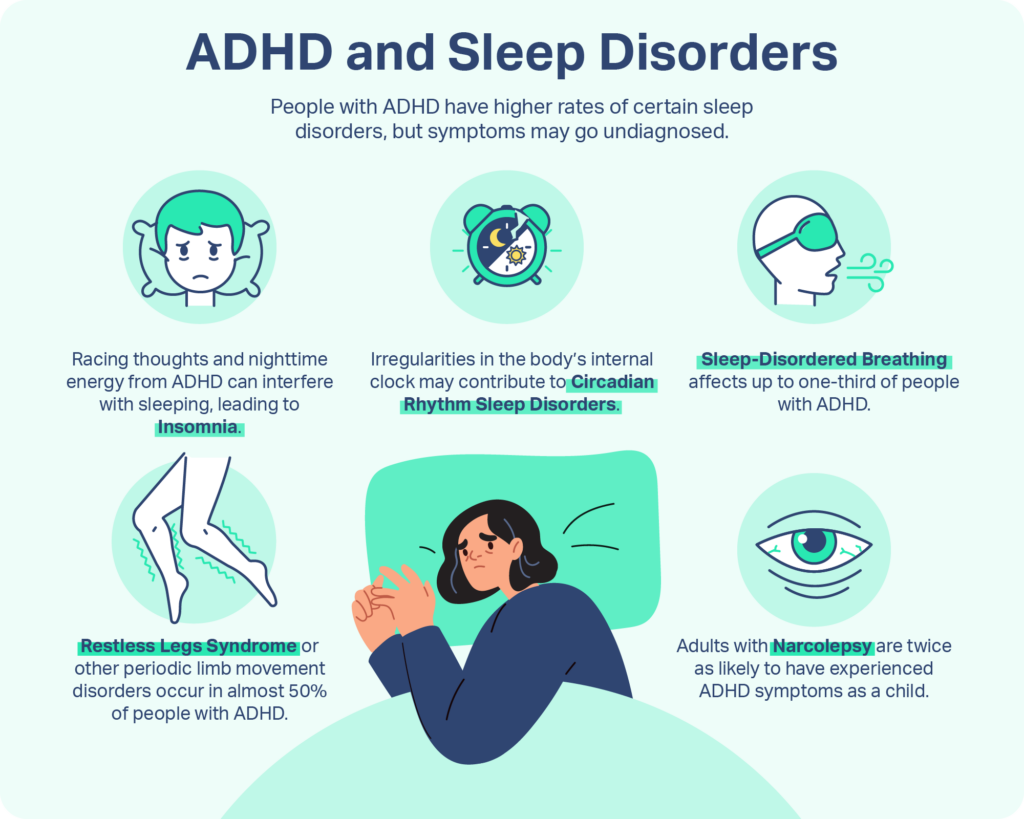
People with ADHD have higher rates of certain sleep disorders. Because ADHD symptoms often resemble the symptoms of these sleep disorders, underlying sleep disorders may go undiagnosed. Children in particular may have difficulty conveying what they are feeling, leading to a misdiagnosis of ADHD when in fact their problems stem from a sleep disorder. Or, they may have ADHD plus a sleep disorder, including these common comorbidities.
Insomnia
Those who are rarely hyperactive during the day may still experience racing thoughts and nighttime energy spurts that interfere with sleeping, leading to insomnia. For some, nighttime presents the perfect opportunity to hyperfocus on a project, as there are less distractions. Unfortunately, this makes it difficult to settle down for sleep and can lead to a dysregulated sleep-wake schedule. Over time, insomnia may worsen as people start to develop feelings of stress associated with bedtime.
Many people with ADHD experience daytime sleepiness and difficulty waking up as a result of poor sleep. Others experience restless, non-refreshing sleep with multiple nighttime awakenings.
Circadian Rhythm Sleep Disorders
Most individuals with ADHD, particularly adolescents, are more alert in the evening. This atypical schedule can make it difficult to honor work or school commitments. A smaller pineal gland, irregularities in the body’s internal clock, and delayed melatonin release may contribute to circadian rhythm sleep disorders in people with ADHD.
Some researchers believe that ADHD-related sleep problems can be traced to adelayed circadian rhythm with a later onset of melatonin production . Despite similarities between certain sleep disorders and ADHD symptoms, research has failed to find consistent sleep abnormalities in people with ADHD.
Delayed Sleep-Wake Phase Disorder
Delayed sleep-wake phase disorder, also referred to as delayed sleep phase syndrome (DSPS), is a type of circadian rhythm sleep disorder commonly reported in people with ADHD. DSPS is marked by a delay in the sleep-wake cycle of two hours or more, which can impede on time-sensitive activities such as work or school.
DSPS can make it harder to fall asleep at night, which may cause excessive tiredness, confusion, and lack of alertness the following morning. Taking melatonin supplements at targeted times or using bright light therapy may help regulate the sleep-wake cycle and diminish the effects of DSPS.
Sleep-Disordered Breathing
Sleep-disordered breathing (SDB), including snoring and sleep apnea, affects up to one-third of patients with ADHD. SDB leads to disturbed sleep and daytime sleepiness, and often causes symptoms typical of ADHD. Treating SDB may reduce the need for stimulants in children believed to have ADHD. Studies suggest that removing the tonsils may help with ADHD and sleep apnea symptoms in children, while CPAP therapy is considered a better choice for adults.
Restless Legs Syndrome
People with restless legs syndrome (RLS) experience tingling sensations in the legs that make it hard to fall asleep. RLS or other types of periodic limb movement disorders may occur in almost 50% of people with ADHD. Children with both ADHD and RLS appear to spend longer in stage 1 light sleep , which is not as restorative. Researchers believe RLS is caused by iron and dopamine deficiencies, which are commonly associated with ADHD.
Narcolepsy
Individuals with narcolepsy tend to fall asleep suddenly during the day and may have difficulty sleeping soundly at night. Adults with narcolepsy are twice as likely to have experienced ADHD symptoms as a child. While the link between the two is not clear, researchers believe that the sleepiness brought on by narcolepsy may provoke ADHD symptoms. It’s also possible that both disorders stem from a similar cause, such as a gene abnormality or a problem with neurotransmitters. Narcolepsy is usually treated with medication.
Diagnosing and treating underlying sleep disorders is an important step toward improving sleep for people with ADHD. Ask your doctor for a sleep study to rule out any secondary sleep disorders that may need to be treated along with your ADHD. A qualified physician should monitor potential sleep problems on an ongoing basis, as these tend to develop over time.
How to Sleep With ADHD
Experts are cautiously optimistic that sleep interventions may be key to improving not only sleep, but also ADHD symptoms and the effects of ADHD medication . Indeed, preliminary studies have found that behavioral sleep interventions improve sleep, ADHD symptoms, daily functioning, behavior, and working memory.
For children, adolescents, and adults with ADHD, a consistent bedtime routine and healthy sleep hygiene practices can help reinforce the connection between bed and sleep. Try making gradual changes and note where you see improvements to develop a system that works for you. Some tips include:
- Cutting off sugar, caffeine, and alcohol intake within a few hours before bedtime
- Avoiding screen time for an hour before bed
- Avoiding doing stimulating activities and projects that require hyperfocusing in the evening
- Making the bed a stress-free zone reserved for sleep and sex
- Getting enough exercise and sunlight during the day
- Developing a bedtime routine that you enjoy, such as rereading a favorite book, spending time with pets, or taking a warm bath
- Keeping the bedroom dark, cool, and quiet, using a white noise machine if necessary to block out intrusive noises
- Going to bed and waking up at the same time every day, choosing a time that is realistic to get therecommended sleep for your age group
- Using a weighted blanket
People with ADHD frequently report having trouble waking up in the morning. For help getting out of bed, try using light therapy or plan something enjoyable for when you get out of bed, such as exercise or a nice breakfast.
The Children and Adults with ADHD organization recommends using a reward-based system to manage sleep problems in young children with ADHD. Caregivers can also offer reassurance by checking frequently on their child. For people of any age with ADHD, talking with a trusted confidant, keeping a worry journal, or using relaxation techniques such as guided imagery may help make bedtime less stressful.
Treatment Options for ADHD-Related Sleep Problems
Managing sleep problems in people with ADHD usually requires a multifaceted approach that addresses both medical and behavioral factors. While traditional sleep medications are not always recommended, several strategies may help:
- Medication adjustments: For some, shifting the timing of stimulant medications or switching formulations can improve nighttime rest without compromising daytime focus. For example, taking ADHD medication about an hour after waking can help maintain alertness during the day and reduce evening restlessness.
- Supplements: Under medical guidance, certain supplements such as melatonin may support a more consistent sleep-wake cycle, though effectiveness varies from person to person.
- Cognitive Behavioral Therapy for Insomnia (CBT-I): This evidence-based therapy can help adolescents and adults with ADHD reframe anxious thoughts about sleep, establish healthier routines, and improve sleep quality without medication.
- Lifestyle strategies: Good sleep hygiene is especially important for ADHD. Setting a regular bedtime, limiting screen time before bed, exercising during the day, and creating a calming wind-down routine can all make it easier to fall and stay asleep.
- Addressing coexisting conditions: Anxiety, depression, and sleep disorders like sleep apnea can also interfere with rest. Treating these alongside ADHD may significantly improve sleep outcomes.
Because ADHD and sleep interact in complex ways, working with a doctor or sleep specialist is the best way to find a personalized treatment plan.
When to See Your Doctor
If sleep problems are interfering with daily life, it may be time to reach out for professional help. While occasional restlessness or staying up late is common, people with ADHD should consult a doctor or sleep specialist if:
- Difficulty falling or staying asleep occurs several nights a week.
- Daytime fatigue, irritability, or trouble focusing worsens despite treatment.
- You experience excessive sleepiness, such as falling asleep at inappropriate times or needing unusually long sleep periods.
- Sleep disruptions are accompanied by snoring, pauses in breathing, or other symptoms of a sleep disorder.
- Current ADHD medications seem to make sleep problems worse.
A clinician can help determine whether sleep issues stem from ADHD itself, a coexisting condition, or another underlying sleep disorder. With proper evaluation and treatment, most people can find strategies that improve both ADHD management and sleep quality.
Frequently Asked Questions
Is ADHD a sleep disorder?
No, ADHD is not classified as a sleep disorder. It is a neurodevelopmental condition characterized by inattention, hyperactivity, and impulsivity. However, many people with ADHD also experience sleep difficulties, such as insomnia, delayed sleep timing, or restless sleep. These issues may overlap with symptoms of sleep disorders, which is why sleep concerns are common in ADHD care.
Do people with ADHD need more sleep?
People with ADHD don’t necessarily need more sleep than those without the condition, but they often have a harder time getting the recommended amount. Sleep challenges such as trouble falling asleep, frequent awakenings, or restless nights can leave them more fatigued during the day. In practice, this can make healthy sleep routines especially important for people with ADHD.
Is sleeping with wrists bent inward a sign of ADHD?
No, sleeping with wrists bent inward is not considered a sign of ADHD. ADHD symptoms are defined by patterns of attention, hyperactivity, and impulsivity, not sleep posture. While some children and adults with ADHD may have unusual sleep positions or movements due to restlessness, these are not diagnostic features of the condition.

Still have questions? Ask our community!
Join our Sleep Care Community — a trusted hub of sleep health professionals, product specialists, and people just like you. Whether you need expert sleep advice for your insomnia or you’re searching for the perfect mattress, we’ve got you covered. Get personalized guidance from the experts who know sleep best.
Danielle Pacheco is a writer and researcher specializing in sleep health and sleep science. She holds a degree in psychology from the University of British Columbia, where she studied the science of sleep.
Dr. Alex Dimitriu is the founder of Menlo Park Psychiatry and Sleep Medicine. He is board-certified in psychiatry as well as sleep medicine.
Learn more about our medical advisory boardReferences12 Sources
Wajszilber, D., Santiseban, J. A., & Gruber, R. (2018). Sleep disorders in patients with ADHD: impact and management challenges. Nature and science of sleep, 10, 453–480.
https://pubmed.ncbi.nlm.nih.gov/30588139/Grünwald, J., & Schlarb, A. A. (2017). Relationship between subtypes and symptoms of ADHD, insomnia, and nightmares in connection with quality of life in children. Neuropsychiatric disease and treatment, 13, 2341–2350.
https://pubmed.ncbi.nlm.nih.gov/28919767/Cassoff J., Wiebe S. T., & Gruber R. (2012). Sleep patterns and the risk for ADHD: A review. Nature & Science of Sleep. 4: 73-80.
https://pubmed.ncbi.nlm.nih.gov/23620680/Gamble, K. L., May, R. S., Besing, R. C., Tankersly, A. P., & Fargason, R. E. (2013). Delayed sleep timing and symptoms in adults with attention-deficit/hyperactivity disorder: a controlled actigraphy study. Chronobiology international, 30(4), 598–606.
https://pubmed.ncbi.nlm.nih.gov/23445512/Children and Adults with Attention-Deficit/Hyperactivity Disorder. (2020, June). How can we help children with ADHD get a better night’s Sleep?
https://chadd.org/attention-article/how-can-we-help-children-with-adhd-get-a-better-nights-sleep/Lunsford-Avery J. R., & Kollins S. H. (2018). Editorial Perspective: Delayed circadian rhythm phase: a cause of late-onset attention-deficit/hyperactivity disorder among adolescents? Journal of Child Psychology and Psychiatry, and Allied Disciplines. 59(12):1248-1251.
https://pubmed.ncbi.nlm.nih.gov/30176050/American Academy of Sleep Medicine. (2014). The International Classification of Sleep Disorders – Third Edition (ICSD-3). Darien, IL.
https://aasm.org/clinical-resources/international-classification-sleep-disorders/Sedky, K., Bennett, D. S., & Carvalho, K. S. (2014). Attention deficit hyperactivity disorder and sleep disordered breathing in pediatric populations: a meta-analysis. Sleep medicine reviews, 18(4), 349–356.
https://pubmed.ncbi.nlm.nih.gov/24581717/Ferri, R., Bruni, O., Novelli, L., Picchietti, M. A., & Picchietti, D. L. (2013). Time structure of leg movement activity during sleep in attention-deficit/hyperactivity disorder and effects of levodopa. Sleep medicine, 14(4), 359–366.
https://pubmed.ncbi.nlm.nih.gov/23415543/Hiscock, H., Sciberras, E., Mensah, F., Gerner, B., Efron, D., Khano, S., & Oberklaid, F. (2015). Impact of a behavioural sleep intervention on symptoms and sleep in children with attention deficit hyperactivity disorder, and parental mental health: randomised controlled trial. BMJ (Clinical research ed.), 350, h68.
https://pubmed.ncbi.nlm.nih.gov/25646809/Morash-Conway, J., Gendron, M., & Corkum, P. (2017). The role of sleep quality and quantity in moderating the effectiveness of medication in the treatment of children with ADHD. Attention Deficit and Hyperactivity Disorders, 9(1), 31–38.
https://pubmed.ncbi.nlm.nih.gov/27515452/Yehuda, S., Rabinovitz-Shenkar, S., & Carasso, R. L. (2011). Effects of essential fatty acids in iron deficient and sleep-disturbed attention deficit hyperactivity disorder (ADHD) children. European journal of clinical nutrition, 65(10), 1167–1169.
https://pubmed.ncbi.nlm.nih.gov/21587279/