When you buy through our links, we may earn a commission. Products or services may be offered by an affiliated entity. Learn more.

How to Sleep With Tinnitus


- White noise, fans, calming sounds, and other forms of sound therapy may help mask tinnitus at bedtime.
- A consistent bedtime routine, stress management, and limiting caffeine, alcohol, and tobacco may improve sleep and reduce symptom flare-ups.
- Persistent or bothersome tinnitus should be discussed with a doctor, who can look for an underlying cause and recommend treatment options.
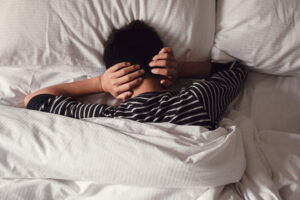
Tinnitus is a common medical condition in which a person hears ringing, buzzing, or other sounds that do not come from an external source. While the causes and severity of tinnitus differs from person to person, people often report that tinnitus can make it difficult to concentrate during the day and fall asleep at night.
For many people with tinnitus, silence makes their symptoms more noticeable at bedtime. Because losing sleep can further exacerbate tinnitus and increase stress and anxiety, it’s important for people with tinnitus to find ways to cope with nighttime symptoms. Fortunately, tinnitus can often be managed and several strategies may help to reduce symptoms.
Looking to improve your sleep? Try upgrading your mattress.

1. Try White Noise
Many experts suggest using white noise to mask the sound of tinnitus. Ambient noise can distract from the sounds of tinnitus and make it easier to fall asleep. Simple ways of producing white noise at bedtime include:
- Gentle music from a bedside speaker
- A sound machine
- An overhead or bedside fan
- Turning on a humidifier or dishwasher
Additionally, the use of pleasant or calming sounds, such as waves crashing or rain falling can also help distract the brain from tinnitus.
Because loud sounds can cause tinnitus and make it worse , it’s important to protect hearing by keeping the volume of white noise low.
2. Elevate Your Pillow
Tinnitus can be caused by a variety of medications and medical conditions, including loud noises, hearing loss, and ear infections. In some cases, congestion from inflammation or mucus can contribute to symptoms. In these cases it may be helpful to elevate the top of the bed or prop up the head with pillows to reduce congestion.

3. Create a Bedtime Routine
Creating a regular bedtime routine can signal to the body that it’s time to wind down and prepare for sleep. Consistent habits before bed, like reading a book, avoiding screen time, taking a warm bath, or practicing relaxation exercises, can help people fall asleep faster and get better quality sleep.
Managing stress improves sleep and is an important part of living with tinnitus because stress and anxiety can worsen tinnitus symptoms. Therefore, incorporating stress-reducing activities, such as meditation or deep breathing exercises, into a bedtime routine can be beneficial. Overall, healthy sleep hygiene can decrease the time it takes to fall asleep and achieve better quality sleep which has shown to reduce tinnitus.
4. Reduce Caffeine, Alcohol, and Tobacco
Caffeine is a stimulant found in coffee, tea, chocolate, and many energy drinks and sodas. Consuming caffeine late in the day can interfere with sleep and make the symptoms of tinnitus worse. Experts advise avoiding caffeine for at least eight hours before bedtime.
Both drinking alcohol and smoking tobacco can also worsen tinnitus. Reducing or eliminating these substances is another important step in managing tinnitus.
5. Talk to a Doctor
It’s important to talk to a doctor about new, persistent, or bothersome tinnitus. A doctor can perform tests and order imaging studies to look for the underlying cause of tinnitus and recommend treatments to reduce the severity of symptoms.
Sometimes tinnitus goes away spontaneously, without any treatment at all. However, there are several treatment options for tinnitus that require a prescription from a doctor. For example, tinnitus maskers are prescription devices that fit like a hearing aid. The device masks sounds from tinnitus by sending soft and consistent noise into the ear.
Although medications are not a common treatment for tinnitus, doctors may recommend medications and other treatments for insomnia , depression, and other effects of tinnitus that interfere with sleep.
6. Find a Specialist
A doctor can also provide a referral to a treatment center, doctor, or mental health professional that specializes in tinnitus. Specialists can provide education and other tools for living with tinnitus , such as therapy and biofeedback.
- Cognitive behavioral therapy (CBT): CBT is a form of counseling that helps people shift the ways they think, feel, and behave in response to tinnitus symptoms.
- Tinnitus retraining therapy (TRT): Tinnitus retraining therapy changes the way the brain responds to tinnitus, making the sounds less noticeable and bothersome. TRT allows the natural ability of the brain to “habituate” a noise so that it does not reach conscious perception. It often includes a combination of sound therapy and counseling.
- Biofeedback: Biofeedback in a technique that can help people learn to notice and control the body’s physical response to tinnitus. Treatment often involves monitoring and learning to regulate breathing, heart rate, and other body functions.
Frequently Asked Questions
Does tinnitus go away?
Tinnitus may go away or improve on its own, especially when it’s caused by a temporary condition like exposure to loud noise, a change in medication, or an ear infection or earwax build-up.
However, tinnitus can also worsen over time. When tinnitus lasts for more than three months, it’s considered chronic. While there’s no cure for chronic tinnitus, there are treatments to help manage symptoms that range from sound therapy to behavioral therapy, depending on the cause
.
Can tinnitus cause sleep apnea?
There’s no conclusive evidence that tinnitus causes obstructive sleep apnea (OSA), but studies suggest that OSA does occur more often in people with tinnitus
. Some scientists have suggested that symptoms of OSA like fragmented sleep and loud snoring could cause tinnitus, but there have been no conclusive clinical studies to prove this idea.
More research is also needed to determine whether shared risk factors like smoking, alcohol consumption, diabetes, or hypertension could be the primary cause of both conditions, rather than one causing the other
.
Do hearing aids help tinnitus?
Hearing aids often improve symptoms of tinnitus for a few reasons. First, they amplify external sounds, which allows the person to focus on the real sounds rather than those created by the tinnitus. Also, as many as 90% of people who have tinnitus also experience hearing loss, which hearing aids directly address.
The American Tinnitus Association suggests that hearing aids may be most effective in treating tinnitus when paired with counseling and a structured tinnitus education program
.
Can stress cause tinnitus?
There’s no definitive evidence that stress single-handedly causes tinnitus, but numerous studies suggest that the two conditions have a close association. People with tinnitus often report stress and emotional disturbances, and research has shown that besides the auditory system, tinnitus also involves neural pathways that regulate emotions.
Many report that stress worsens tinnitus symptoms. In some cases, the tinnitus symptoms then cause more stress, creating a cycle that worsens both conditions
. For this reason, one of the main treatments for tinnitus involves behavior therapy to help manage stress.
Can acupuncture help tinnitus?
Some studies suggest that acupuncture may improve the symptoms of tinnitus, but the evidence is mixed. One study found that acupuncture benefited people with tinnitus that originated in the inner ear, but that the effects wore off quickly
. Another study in the same journal found that acupuncture only showed significant benefits for select patients.
And yet another study found that people with tinnitus gained significant relief for the short term from scalp acupuncture
. Overall, research suggests that acupuncture should only be considered as a complementary treatment for tinnitus, not a primary one.
Can lack of sleep cause tinnitus?
A lack of sleep doesn’t appear to directly cause tinnitus, but it can worsen the symptoms . Specifically, sleep deficiency can make you more reactive and less able to regulate emotions, which can worsen your perception of tinnitus symptoms . Insufficient sleep can also cause stress, which has been shown to worsen symptoms of tinnitus.
Does sleeping with earplugs help tinnitus?
There’s no evidence that sleeping with earplugs improves symptoms of tinnitus, and they aren’t a medically recommended treatment for the condition. Earplugs block out external sound, while tinnitus causes internal “phantom” ringing which earplugs don’t address.
Also, hearing aids are often used as a treatment for tinnitus because amplifying external sounds sometimes helps a person with tinnitus focus on real-world sound instead of the noise of their tinnitus. Because of this, earplugs could make the symptoms of tinnitus seem worse.

Still have questions? Ask our community!
Join our Sleep Care Community — a trusted hub of sleep health professionals, product specialists, and people just like you. Whether you need expert sleep advice for your insomnia or you’re searching for the perfect mattress, we’ve got you covered. Get personalized guidance from the experts who know sleep best.
Jay Vera Summer is a writer, editor, and wellness coach. She holds a Bachelor's of Science in psychology and Master's degrees in both writing and public policy.
Dr. Lulu Guo is a graduate of the prestigious Medical Scholars program at Michigan State University and was admitted into medical school at the age of seventeen after completing undergraduate studies in two years. She is double board-certified in Family and Sleep Medicine.
Learn more about our medical advisory boardReferences18 Sources
Kaylie, D. M. (2022, December). Ear ringing or Buzzing. Merck Manual Consumer Version.
https://www.merckmanuals.com/home/ear,-nose,-and-throat-disorders/symptoms-of-ear-disorders/ear-ringing-or-buzzingDinces, E. (2021, October 6). Patient education: Treatment of tinnitus. D. Deschler (Ed.). UpToDate.
https://www.uptodate.com/contents/treatment-of-tinnitusDinces, E. (2021, October 6). Patient education: Tinnitus (Beyond the basics). D. Deschler (Ed.). UpToDate.
https://www.uptodate.com/contents/tinnitus-ringing-in-the-ears-beyond-the-basicsNational Heart, Lung, and Blood Institute. (2022 March 4). Sleep deprivation and deficiency.
https://www.nhlbi.nih.gov/health/sleep-deprivation/healthy-sleep-habitsDinces, E. (2021, October 6). Patient education: Tinnitus (Beyond the basics). D. Deschler (Ed.). UpToDate.
https://www.uptodate.com/contents/tinnitus-ringing-in-the-ears-beyond-the-basicsA.D.A.M. Medical Encyclopedia. (2022, May 30). Tinnitus. MedlinePlus.
https://medlineplus.gov/ency/article/003043.htmTunkel, D. E., Bauer, C. A., Sun, G. H., Rosenfeld, R. M., Chandrasekhar, S. S., Cunningham, E. R., Jr, Archer, S. M., Blakley, B. W., Carter, J. M., Granieri, E. C., Henry, J. A., Hollingsworth, D., Khan, F. A., Mitchell, S., Monfared, A., Newman, C. W., Omole, F. S., Phillips, C. D., Robinson, S. K., … Whamond, E. J. (2014). Clinical practice guideline: tinnitus. Otolaryngology Head and Neck Surgery, 151(2 Suppl), S1–S40.
https://pubmed.ncbi.nlm.nih.gov/25273878/NIH Office of Communications and Public Liaison. (2022, May). Noise complaints.
https://newsinhealth.nih.gov/2022/05/noise-complaintsNational Institute on Deafness and Other Communication Disorders. (2023 May 3). Sleep deprivation and deficiency.
https://www.nidcd.nih.gov/health/tinnitusMedlinePlus: National Library of Medicine (US). (2021, November 9). Biofeedback.
https://medlineplus.gov/ency/article/002241.htmAwad M, Abdalla I, Jara SM, Huang TC, Adams ME, Choi JS. Association of Sleep Characteristics with Tinnitus and Hearing Loss. OTO Open. 2024;8(1):e117. Published 2024 Feb 28. doi:10.1002/oto2.117
https://pubmed.ncbi.nlm.nih.gov/38420352/Lee SJ, Park SI, Choi IS, Lee HJ, Lee JM. Exploring a Possible Link Between Tinnitus and the Risk of Obstructive Sleep Apnea-A National Population-Based Cohort Study Using Propensity Score Matching Analysis. J Clin Med. 2025;14(21):7492. Published 2025 Oct 23. doi:10.3390/jcm14217492
https://pubmed.ncbi.nlm.nih.gov/41226889/American Tinnitus Association. Hearing aids/masking devices.
https://www.ata.org/about-tinnitus/therapy-and-treatment-options/hearing-aids-masking-devices/Patil JD, Alrashid MA, Eltabbakh A, Fredericks S. The association between stress, emotional states, and tinnitus: a mini-review. Front Aging Neurosci. 2023;15:1131979. Published 2023 May 3. doi:10.3389/fnagi.2023.1131979
https://pubmed.ncbi.nlm.nih.gov/37207076/Rogha M, Rezvani M, Khodami AR. The effects of acupuncture on the inner ear originated tinnitus. J Res Med Sci. 2011;16(9):1217-1223.
https://pubmed.ncbi.nlm.nih.gov/22973392/Doi MY, Tano SS, Schultz AR, Borges R, Marchiori LL. Effectiveness of acupuncture therapy as treatment for tinnitus: a randomized controlled trial. Braz J Otorhinolaryngol. 2016;82(4):458-465. doi:10.1016/j.bjorl.2016.04.002
https://pubmed.ncbi.nlm.nih.gov/27210823/Wang S, Cha X, Li F, et al. Associations between sleep disorders and anxiety in patients with tinnitus: A cross-sectional study. Front Psychol. 2022;13:963148. Published 2022 Aug 5. doi:10.3389/fpsyg.2022.963148
https://www.frontiersin.org/journals/psychology/articles/10.3389/fpsyg.2022.963148/fullNational Heart, Lung, and Blood Institute. (2022, June 15). Sleep deprivation and deficiency: How sleep affects your health.
https://www.nhlbi.nih.gov/health/sleep-deprivation/health-effects