When you buy through our links, we may earn a commission. Products or services may be offered by an affiliated entity. Learn more.

Maladaptive Daydreaming


- Definition: Maladaptive daydreaming occurs when a person frequently has intense, vivid daydreams that distract from their real-life responsibilities.
- Symptoms: Maladaptive daydreams often include detailed plotlines and characters, last for minutes or hours, and are accompanied by unconscious facial expressions.
- Causes: People may engage in maladaptive daydreaming to escape unpleasant feelings, like those stemming from current problems, past trauma, or depression.
- Treatment: Treatment includes therapy for maladaptive daydreaming and related mental health conditions. Sleep hygiene practices may also help, if daydreams interfere with sleep.
It’s common to get lost in your thoughts every once in a while. Experts estimate we spend about 47% of our waking hours daydreaming, momentarily distracted from the world around us as we let our mind wander. But, if your daydreams are so intense that they feel addictive and interfere with your daily life, you could be experiencing maladaptive daydreaming.
What Is Maladaptive Daydreaming?
Sometimes called daydreaming disorder , maladaptive daydreaming describes an experience in which a person regularly has daydreams that are so intense and distracting that they interfere with work or social activities. These daydreams can be richly detailed and may feature an idealized version of the daydreamer.
Maladaptive daydreaming was first defined in 2002 by researcher Eli Somer, who argues that people with maladaptive daydreaming have a clinical disorder . However, it isn’t currently recognized as a disorder in the Diagnostic and Statistical Manual of Mental Disorders (DSM-5).
Your best sleep starts with the right mattress.
Our expert testing team tried 300+ mattresses to find the top ones for every sleeping style. See our favorite mattresses of 2026 here.
- In-depth ratings and comparisons
- Regularly updated with new products and testing data
- Options for all types of sleepers

Who Is Most at Risk?
People with certain mental disorder symptoms may face an increased risk of maladaptive daydreaming, and more than half of maladaptive daydreamers have a mental health disorder. Studies have found that maladaptive daydreaming is linked with the following issues:
- Attention-deficit/hyperactivity disorder (ADHD)
- Depression
- Anxiety
- Obsessive-compulsive disorder (OCD)
- Emotional dysregulation
- Recent or childhood trauma
- Feelings of shame
- Feelings of emotional distress
- Loneliness
- Personality disorders
- Increased internet use
- Low self-esteem
- Heavy alcohol use
- Dissociation (detaching from one’s body, self, or surroundings)
- Suicidal thoughts and suicide attempts
- Psychotic symptoms
- Autism spectrum disorder (ASD)
Due to the nature of the symptoms, maladaptive daydreaming can be confused with schizophrenia; however, these conditions are very different. Most notably, individuals who experience maladaptive daydreaming know that their daydreams are not real, while those with disorders like schizophrenia have difficulty distinguishing reality from fantasy .
How Common Is Maladaptive Daydreaming?
An Israeli study found that 2.5% of participants experienced maladaptive daydreaming . This number increased to between 5.5% and 8.5% when looking at younger participants, suggesting teens and young adults may be more likely to experience maladaptive daydreaming than older adults .
Researchers also found that 20.5% of people with ADHD experience maladapative daydreaming. More research is needed to clarify how common maladaptive daydreaming is among people with other overlapping disorders.
Symptoms of Maladaptive Daydreaming
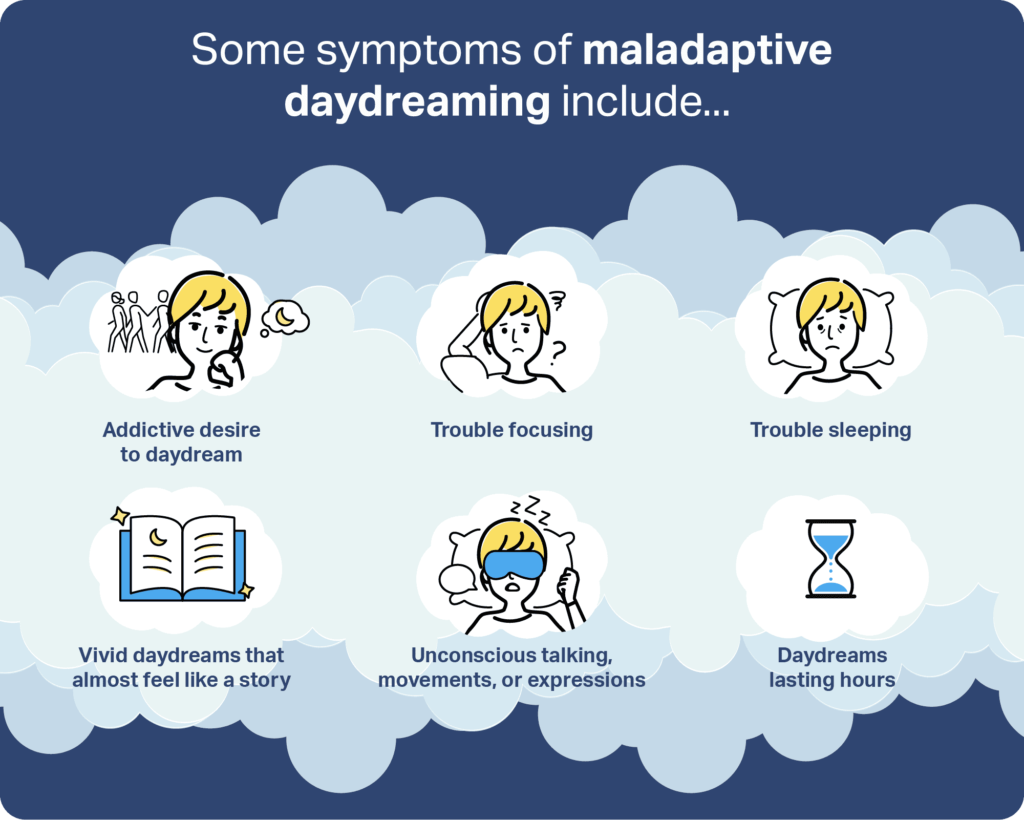
Maladaptive daydreaming symptoms include:
- Intense, vivid daydreams that present as a story with characters, settings, and plotlines
- Trouble focusing and completing daily tasks due to daydreams
- Daydreams that last for several minutes to hours
- Daydreams that may be triggered by real-life events or sensory stimuli
- Unconscious facial expressions, body movements, or whispering related to daydreams
- A compulsive or addictive desire to keep daydreaming
- Feelings of irritation when daydreams are interrupted
- Unsuccessful attempts to stop daydreaming or to daydream less often
- Negative emotions, like shame and guilt, about the daydreams
- Trouble sleeping due to a desire to daydream instead
Causes of Maladaptive Daydreaming
The researchers who believe that maladaptive daydreaming is a distinct mental health issue have suggested that it might have causes similar to those of other mental illnesses. Mental health disorders are thought to develop due to a person’s biology, including their genetics, as well as their environment, which includes social life, stressors, lifestyle, and other factors.
Among people who have them, maladaptive daydreams may be triggered by real-life events or stimuli, such as a noise, smell, conversation topic, or movie scene. Maladaptive daydreaming may also develop as a coping strategy in response to stress or trauma, as the inner world may feel safer than the experience happening externally.
For example, people engaged in maladaptive daydreaming more frequently during the COVID-19 lockdown, reporting that they felt a greater urge to daydream and the vividness of their daydreams intensified.
Maladaptive Daydreaming Diagnosis
Because maladaptive daydreaming isn’t currently listed as a mental health condition in the DSM-5, there aren’t agreed-upon diagnostic criteria, and it can’t be officially diagnosed as a disorder at this time. That said, researchers have developed tools to assess whether or not a person engages in maladaptive daydreaming, including proposed diagnostic criteria.
Maladaptive Daydreaming Test
Three tools are commonly used to assess maladaptive daydreaming in research studies on the topic. However, many clinicians are not familiar with maladaptive daydreaming and may not offer these assessments to clients.
- Maladaptive Daydreaming Scale(MDS-16): Originally a 14-part self-assessment, the MDS-16 now contains 16 items . These questions ask people to self-report symptoms they experience, allowing clinicians to identify if maladaptive daydreaming is present, as well as what might trigger it for a particular person.
- Maladaptive Daydreaming Short Form (MD-SF5): The MD-SF5 is a shortened version of the MDS-16 that only contains five questions. Research shows that this shortened scale aligns with the MDS-16, identifying maladaptive daydreaming well and in less time.
- Structured Clinical Interview for Maladaptive Daydreaming (SCI-MD): In structured clinical interviews, a clinician asks questions related to the diagnostic criteria for the disorder they are screening a person for. Although maladaptive daydreaming doesn’t have official diagnostic criteria, some researchers have proposed diagnostic criteria, and others have used these criteria to conduct structured clinical interviews .

Complications of Maladaptive Daydreaming
Because maladaptive daydreams are often lengthy and involved, they can negatively impact a person’s relationships, work or school performance, sleep, and daily life. Studies of medical students have found that those who engaged in maladaptive daydreaming reported a significant decline in their GPA .
In general, people who daydream are more likely to have troubled sleep. People who engage in maladaptive daydreaming may struggle to sleep, because they’d prefer to daydream. Poor sleep can cause sleep deprivation, which impairs one’s ability to focus, which is a symptom of maladaptive daydreaming. In addition, some of the mental health conditions linked to maladaptive daydreaming, such as anxiety and depression, are associated with poor sleep.
How to Stop Maladaptive Daydreaming
There’s no official course of treatment for maladaptive daydreaming. Typically, treatment focuses on reducing the likelihood of experiencing maladaptive daydreams through therapy and, if relevant, sleep changes.
Get Support
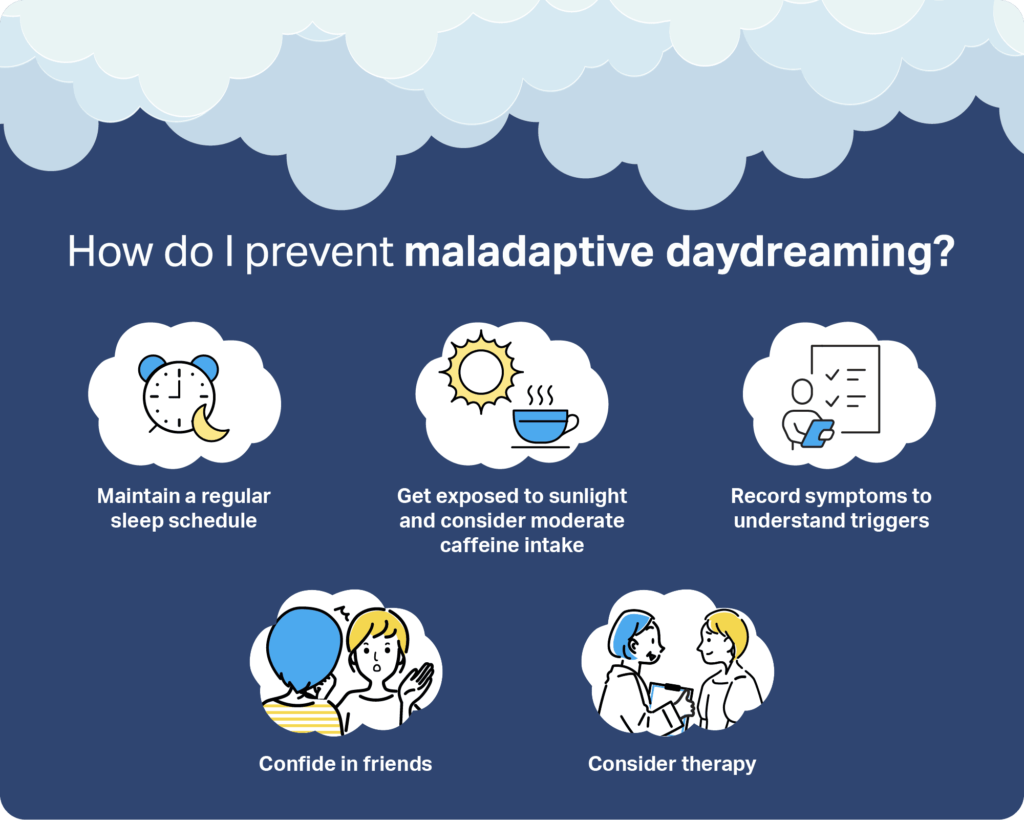
Explain your symptoms to people you trust, like family members and friends. This may help prevent your daydreams from straining relationships while also enabling people to help you by interrupting you when they notice you daydreaming.
Many people also use online forums, social media, and other websites to connect with others who have maladaptive daydreams. While forums and online sources of support haven’t been formally studied to see if they can reduce maladaptive daydreaming, some people claim connecting with others who experience the same problem is helpful.
Consider Therapy
A therapist can help you process any underlying trauma and perhaps identify what’s triggering your maladaptive daydreaming. They can also recommend specific strategies for managing symptoms. For example, grounding techniques can be helpful. Some therapists may also recommend changing your daydream’s plot endings from good to bad to make the daydream less rewarding.
Understand Your Symptom Triggers
Use a small notepad or the notes app on your phone to record what you were doing before you had a maladaptive daydream. Once you know what your triggers are, you can take steps to avoid them or understand why they’re triggering you.
Improve Your Sleep
Adopting better sleep habits can improve your sleep quality, which may be helpful if maladaptive daydreaming is negatively impacting your sleep.
- Set and follow a regular sleep schedule every day of the week, even on weekends.
- Provide yourself with enough time to enjoy however much sleep you require, which falls between 7 to 9 hours for most people.
- Establish a calming bedtime routine to help you relax into sleep.
- Exercise daily and eat healthy meals, but not close to bedtime.
Frequently Asked Questions
What’s the difference between healthy daydreaming and maladaptive daydreaming?
Daydreams are a healthy form of mind wandering. They’re typically pleasant and offer several benefits, such as the ability to plan future events, relieve ourselves from boredom, find meaning in our life’s story, and boost creativity
. Although people may often drift into daydreaming, they can easily stop when needed and don’t feel strongly pulled to continue a specific daydreaming storyline.
While maladaptive daydreams are pleasant as well, they have a negative effect overall. Unlike adaptive or helpful daydreams, maladaptive daydreams commonly enter the realm of fantasy and may feature the daydreamer in an idealistic form or situation. Daydreamers feel compelled to continue these daydreams and may remain in them for minutes or even hours at a time. As a result, the daydreams interfere with daily life, including school, work, and relationships.
Is maladaptive daydreaming a form of OCD?
No, maladaptive daydreaming isn’t a form of OCD, but the two are related. Many people who have maladaptive daydreams also have obsessive-compulsive disorder (OCD)
.
Some studies indicate that people have obsessive-compulsive symptoms prior to an increase in maladapative daydreams, which can then increase obsessive-compulsive symptoms. Dissociation, intrusive thoughts, and difficulty controlling the mind are also present with both issues.
Is maladaptive daydreaming just ADHD?
No, maladaptive daydreaming is not just ADHD, but research shows that people with ADHD are more likely to have maladaptive daydreams than the general public. That said, research also suggests that the majority of people with ADHD do not have maladaptive daydreams. People with ADHD who also have maladaptive daydreams have been found to be lonelier and have lower self-esteem than those with ADHD who don’t have maladaptive daydreams.

Still have questions? Ask our community!
Join our Sleep Care Community — a trusted hub of sleep health professionals, product specialists, and people just like you. Whether you need expert sleep advice for your insomnia or you’re searching for the perfect mattress, we’ve got you covered. Get personalized guidance from the experts who know sleep best.
Jay Vera Summer is a writer, editor, and wellness coach. She holds a Bachelor's of Science in psychology and Master's degrees in both writing and public policy.
Dr. Bagot is a board-certified adult and child and adolescent psychiatrist. She received her B.A. in Psychological & Brain Sciences at Johns Hopkins University, and completed the six-year Albert J. Solnit Integrated Child, Adolescent and Adult Psychiatry Program at Yale University School of Medicine and Child Study Center.
Learn more about our medical advisory boardReferences17 Sources
Killingsworth, M. A., & Gilbert, D. T. (2010). A wandering mind is an unhappy mind. Science (New York, N.Y.), 330(6006), 932.
https://pubmed.ncbi.nlm.nih.gov/21071660/Soffer-Dudek, N., & Somer, E. (2018). Trapped in a daydream: daily elevations in maladaptive daydreaming are associated with daily psychopathological symptoms. Frontiers in Psychiatry, 9, 194.
https://pubmed.ncbi.nlm.nih.gov/29867613/Somer, E. (2002). Maladaptive daydreaming: A qualitative inquiry. Journal of Contemporary Psychotherapy: On the Cutting Edge of Modern Developments in Psychotherapy, 32(2-3), 197–212.
https://psycnet.apa.org/record/2002-11146-005Somer E, Herscu O, Samara M, Abu-Rayya HM. Maladaptive Daydreaming and Psychopathology: A Meta-Analysis. Int J Psychol. 2025;60(2):e70027. doi:10.1002/ijop.70027
https://pubmed.ncbi.nlm.nih.gov/39999955/American Psychiatric Association. (2013). Diagnostic and statistical manual of mental disorders (5th ed.).
https://psychiatryonline.org/doi/book/10.1176/appi.books.9780890425596Soffer-Dudek N, Oh H. Maladaptive daydreaming: A shortened assessment measure and its mental health correlates in a large United States sample. Compr Psychiatry. 2024;129:152441. doi:10.1016/j.comppsych.2023.152441
https://pubmed.ncbi.nlm.nih.gov/38061294/National Institute of Mental Health. (2020, May). Schizophrenia. NIMH.
https://www.nimh.nih.gov/health/topics/schizophrenia/index.shtmlTheodor-Katz N, Somer E, Hesseg RM, Soffer-Dudek N. Could immersive daydreaming underlie a deficit in attention? The prevalence and characteristics of maladaptive daydreaming in individuals with attention-deficit/hyperactivity disorder. J Clin Psychol. 2022;78(11):2309-2328. doi:10.1002/jclp.23355
https://pubmed.ncbi.nlm.nih.gov/35355262/Soffer-Dudek N, Theodor-Katz N. Maladaptive Daydreaming: Epidemiological Data on a Newly Identified Syndrome. Front Psychiatry. 2022;13:871041. Published 2022 Apr 27. doi:10.3389/fpsyt.2022.871041
https://pubmed.ncbi.nlm.nih.gov/35573338/Pietkiewicz, I. J., Nęcki, S., Bańbura, A., & Tomalski, R. (2018). Maladaptive daydreaming as a new form of behavioral addiction. Journal of Behavioral Addictions, 7(3), 838–843.
https://pubmed.ncbi.nlm.nih.gov/30238787/Somer, E., Abu-Rayya, H. M., Schimmenti, A., Metin, B., Brenner, R., Ferrante, E., Göçmen, B., & Marino, A. (2020). Heightened levels of maladaptive daydreaming are associated with COVID-19 lockdown, pre-existing psychiatric diagnoses, and intensified psychological dysfunctions: a multi-country study. Frontiers in Psychiatry, 11, 587455.
https://pubmed.ncbi.nlm.nih.gov/33240135/Somer, E., Lehrfeld, J., Bigelsen, J., & Jopp, D. S. (2016). Development and validation of the Maladaptive Daydreaming Scale (MDS). Consciousness and Cognition, 39, 77–91.
https://pubmed.ncbi.nlm.nih.gov/26707384/Somer E, Soffer-Dudek N, Ross CA, Halpern N. Maladaptive daydreaming: Proposed diagnostic criteria and their assessment with a structured clinical interview. Psychology of Consciousness: Theory, Research, and Practice. 2017;4(2):176-189. doi:https://doi.org/10.1037/cns0000114
https://www.researchgate.net/publication/313029607_Maladaptive_daydreaming_Proposed_diagnostic_criteria_and_their_assessment_with_a_structured_clinical_interviewAlenizi, M. M., Alenazi, S. D., Almushir, S., Alosaimi, A., Alqarni, A., Anjum, I., & Omair, A. (2020). Impact of maladaptive daydreaming on grade point average (GPA) and the association between maladaptive daydreaming and generalized anxiety disorder (GAD). Cureus, 12(10), e10776.
https://pubmed.ncbi.nlm.nih.gov/33033669/Marcusson-Clavertz, D., West, M., Kjell, O., & Somer, E. (2019). A daily diary study on maladaptive daydreaming, mind wandering, and sleep disturbances: Examining within-person and between-persons relations. PloS One, 14(11), e0225529.
https://pubmed.ncbi.nlm.nih.gov/31774836/Smallwood, J., & Schooler, J. W. (2015). The science of mind wandering: empirically navigating the stream of consciousness. Annual Review of Psychology, 66, 487–518.
https://pubmed.ncbi.nlm.nih.gov/25293689/Salomon-Small, G., Somer, E., Harel-Schwarzmann, M., & Soffer-Dudek, N. (2021). Maladaptive daydreaming and obsessive-compulsive symptoms: A confirmatory and exploratory investigation of shared mechanisms. Journal of Psychiatric Research, 136, 343–350.
https://pubmed.ncbi.nlm.nih.gov/33636690/