

When you buy through our links, we may earn a commission. Products or services may be offered by an affiliated entity. Learn more.
Sleep Calculator
Your Personalized Tool for Better Sleep
Instructions: Enter your age and either the time you want to wake up or the time you plan to go to bed. The calculator allows 15 minutes to fall asleep, then suggests times that line up with average sleep-cycle length.

Sleep Calculator
Age Range
Sleep Schedule


Note: The calculator estimates bedtime and wake times based on your age, recommended sleep duration, and typical sleep-cycle length. Because sleep cycles vary from person to person and throughout the night, these times should be used as a general planning guide rather than exact targets.
- Most healthy adults should aim for 7 to 9 hours of sleep a night, though the exact amount depends on your age (ex. children need more sleep), activity level, and health status.
- To find your bedtime, count back from your wake-up time in full sleep cycles and add about 15 minutes to fall asleep. (Tip: The calculator above does this for you!)
- Sleep cycles vary in length, so calculator results are estimates; getting enough total sleep is more important than waking at an exact cycle endpoint.
- It’s important to stick to a consistent sleep schedule, going to sleep and waking up at the same time every day.
Sleep is a critical pillar of health. The quality of your sleep affects nearly every part of your health, including your immune system, heart health, metabolism, and ability to think clearly. Use the sleep calculator above to plan a sleep schedule based on your age and either the time you want to go to bed or the time you need to wake up.
Remember, though, the calculator only gives you a starting point. If you regularly wake up tired despite a consistent schedule, talk with your doctor.
How Much Sleep Do I Need?
Some people do not know how much sleep they should get or simply do not budget enough time for sleep . Most adults should get 7 to 9 hours of sleep per night. Babies, young children, and teens need more sleep than adults do.
The following sleep recommendations provide an overview of how much sleep most people need, but the exact amount of sleep a specific person should get depends on other factors , such as their overall health. A doctor is in the best position to make a detailed sleep recommendation for any individual based on their unique situation.
| Age Range | Recommended Daily Sleep | |
|---|---|---|
| Newborn | 0 to 3 months | 14 to 17 hours (including naps) |
| Infant | 4 to 11 months | 12 to 16 hours (including naps) |
| Toddler | 1 to 2 years | 11 to 14 hours (including naps) |
| Preschool | 3 to 5 years | 10 to 13 hours (including naps) |
| School-Age | 6 to 12 years | 9 to 12 hours |
| Teens | 13 to 18 years | 8 to 10 hours |
| Adult | 18 to 64 years | 7 to 9 hours |
| Older Adults | 65 and older | 7 to 8 hours |
What Time Should I Go to Bed?
There’s no “one size fits all” bedtime, but there are ways to determine optimal bed and wake-up times based on age, geographic location, lifestyle preferences, and obligations like work and school. One way to find your bedtime: Start with the time you need to wake up, count backward by full sleep cycles, then add about 15 minutes to fall asleep.
Experts suggest sticking to a consistent sleep schedule, waking up and falling asleep at the same time each day, even on weekends and days off. It’s also generally healthiest to be awake during the majority of daylight hours, and asleep during dark periods.
What Time Should I Wake Up?
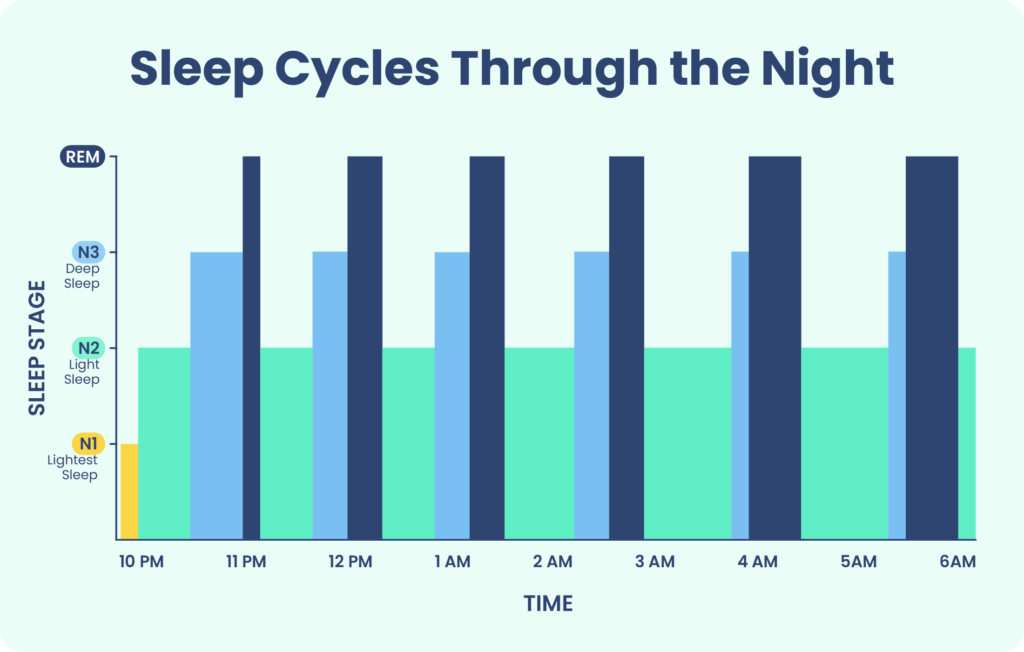
Choose a wake-up time that allows you to get enough total sleep and that you can maintain consistently from day to day. Although waking from deeper sleep can contribute to temporary grogginess , sleep cycles vary in length, so it isn’t possible to reliably schedule your alarm for the exact end of a cycle.
The average adult cycles through each stage of sleep several times per night, with each sleep cycle lasting approximately 90 to 120 minutes . Most adults should prioritize getting 7 to 9 hours of sleep, rather than targeting a specific number of sleep cycles.
For the most accurate results, use the sleep calculator above to determine the best wake-up time based on your age and bedtime.

Why Is It Important to Get Enough Sleep?
Sleep is critical for nearly every system of the body. Getting enough sleep each night gives the brain and body time to recover, regulate hormones, support immune function, consolidate memories, and restore energy for the next day. Consistently getting enough high-quality sleep also supports attention, mood, physical performance, and overall health.
When sleep is too short or repeatedly disrupted, these restorative processes can be affected. Over time, insufficient sleep can lead to noticeable changes in how you think, feel, and function and may contribute to longer-term health problems.
Consequences of Sleep Deprivation
Sleep deprivation has short- and long-term impacts on physical, emotional, and mental health . Immediately following a night of poor sleep, you may experience:
- Lack of energy
- Excessive daytime sleepiness
- Difficulty focusing
- Dozing off unexpectedly, which can be especially risky while driving
- Worsened reaction time, which can increase the risk of accidents
- Irritability and mood problems
- Problems with cognitive function, including memory, decision-making, and problem-solving abilities
- Decreased physical performance
- Impaired immune system, increasing the risk of getting sick
On a long-term basis, lack of sleep has been linked to a wide range of health problems , including:
- Weight gain and obesity
- Diabetes,
- Heart disease and other cardiovascular issues
- Depression and anxiety
- Increased sensitivity to pain
- Hormonal abnormalities
- Reduced quantity and quality of life
How Do I Get Better Sleep?
A number of simple lifestyle changes can be implemented to improve sleep, which can lead to better physical, cognitive, and emotional wellness.
- Dedicate time to self-care: Developing a relaxing routine before bed can promote healthy sleep. Try yoga, meditation, journaling, reading, or listening to calming music.
- Avoid caffeine: Stimulants, especially when ingested in the afternoon and evening, can disrupt the body’s circadian rhythm, the internal 24-hour clock that regulates when you feel sleepy and alert, making it harder to fall and stay asleep.
- Reduce alcohol consumption before bed: Research has shown that alcohol consumption hinders sleep quality.
- Put away electronic devices: Smartphones, tablets, and other electronic devices emit blue light that can disrupt circadian rhythms and hinder production of melatonin, a hormone that signals to your body that it’s time to sleep, in the brain. Aim to put them away at least 30 minutes before bedtime.
- Exercise daily: Even low-impact movement, such as a 30-minute walk, can have a positive impact on sleep.
- Get some sunlight: Exposure to natural light suppresses melatonin production during waking hours and helps regulate circadian timing, boosting daytime alertness and promoting relaxation during the night.
- Make the bedroom dark and quiet: A tranquil bedroom free of both natural and artificial light can train the body to associate that space with sleep. A sleep mask and earplugs can reduce disruptions.
- Choose a supportive mattress: Everyone is unique, and preferences for sleep accessories vary. Finding the right mattress and bedding can contribute to a more comfortable sleep environment.
When to Talk to a Doctor
If you regularly get enough time in bed but still wake up feeling unrefreshed, struggle to stay awake during the day, or have ongoing trouble falling or staying asleep, it may be worth talking with a doctor. Persistent sleep problems can sometimes point to an underlying condition rather than simply an inconsistent schedule.
You should also seek medical advice if you experience loud snoring, gasping or choking during sleep, witnessed breathing pauses, frequent morning headaches, unusual movements during sleep, or excessive daytime sleepiness that affects work, school, driving, or daily activities. A doctor can help determine whether a sleep disorder or another health condition may be interfering with your rest and recommend appropriate testing or treatment.
Frequently Asked Questions
Is 10 p.m. to 7 a.m. enough sleep?
From 10 p.m. to 7 a.m. is 9 hours in bed, which is enough for most adults if you’re actually sleeping for most of that time. Individual sleep needs vary, and time spent awake during the night can reduce your total sleep time.
How do I calculate my sleep?
Subtract the time you fall asleep from the time you wake up, then subtract any time spent awake during the night. For example, if you sleep from 11 p.m. to 7 a.m. but are awake for 30 minutes overnight, your total sleep time is about 7.5 hours.
Is 9:30 p.m. to 4:30 a.m. enough sleep?
From 9:30 p.m. to 4:30 a.m. is 7 hours in bed. That may be enough for some adults, but it leaves little room for time spent falling asleep or waking during the night, so your actual sleep time may be less than 7 hours.
Are sleep calculators accurate?
Sleep calculators can help you estimate a bedtime or wake time that allows for enough sleep, but they cannot predict your exact sleep stages or cycle timing. Sleep needs and sleep-cycle length vary from person to person and from night to night, so calculator results are best used as a general planning guide.
Is every sleep cycle exactly 90 minutes?
No, sleep cycles are often described as lasting about 90 minutes, but their actual length varies throughout the night and between individuals. Because of this, it’s more important to get enough total sleep than to try to wake at the exact end of a calculated 90-minute cycle.
Is 7.5 hours of sleep better than 8 hours?
Not necessarily. You don’t need to sleep in exact 90-minute increments, so deliberately cutting sleep short to reach 7.5 hours is unlikely to provide a benefit. If 8 hours leaves you feeling rested and falls within your recommended sleep range, there’s no reason to shorten it just to match a certain number of sleep cycles.

Still have questions? Ask our community!
Join our Sleep Care Community — a trusted hub of product specialists, sleep health professionals, and people just like you. Whether you’re searching for the perfect mattress or need expert sleep advice, we’ve got you covered. Get personalized guidance from the experts who know sleep best.

Danielle Pacheco is a writer and researcher specializing in sleep health and sleep science. She holds a degree in psychology from the University of British Columbia, where she studied the science of sleep.

Dr. Abhinav Singh, board certified in Sleep Medicine and Internal Medicine, is the Medical Director of the Indiana Sleep Center, which is accredited by the American Academy of Sleep Medicine. He is also a Clinical Assistant Professor at Marian University College of Medicine in Indianapolis, where he developed and teaches a Sleep Medicine rotation.
Learn more about our medical advisory boardReferences8 Sources
Liu, Y., Wheaton, A. G., Chapman, D. P., Cunningham, T. J., Lu, H., & Croft, J. B. (2016). Prevalence of healthy sleep duration among adults–United States, 2014. MMWR. Morbidity and mortality weekly report, 65(6), 137–141.
https://pubmed.ncbi.nlm.nih.gov/26890214/Paruthi, S., Brooks, L. J., D’Ambrosio, C., Hall, W. A., Kotagal, S., Lloyd, R. M., Malow, B. A., Maski, K., Nichols, C., Quan, S. F., Rosen, C. L., Troester, M. M., & Wise, M. S. (2016). Consensus statement of the American Academy of Sleep Medicine on the recommended amount of sleep for healthy children: Methodology and discussion. Journal of Clinical Sleep Medicine, 12(11), 1549–1561.
https://pubmed.ncbi.nlm.nih.gov/27707447/McNamara, P., Auerbach, S., Johnson, P., Harris, E., Doros, G. (2010). Impact of REM sleep on distortions of self-concept, mood and memory in depressed/anxious participants. Journal of Affective Disorders, 122(3), 198–207.
https://pubmed.ncbi.nlm.nih.gov/19631989/Schwab, R. J. (2022, May). Overview of sleep. Merck Manual Consumer Version.
https://www.merckmanuals.com/home/brain,-spinal-cord,-and-nerve-disorders/sleep-disorders/overview-of-sleepNational Institute of Neurological Disorders and Stroke. (2022, September 26). Brain basics: Understanding sleep.
https://www.ninds.nih.gov/health-information/patient-caregiver-education/brain-basics-understanding-sleepNational Heart, Lung, and Blood Institute (NHLBI). (2022, March 24). Sleep deprivation and deficiency.
https://www.nhlbi.nih.gov/health-topics/sleep-deprivation-and-deficiencyDurmer, J. S. & Dinges, D. F. (2005). Neurocognitive consequences of sleep deprivation. Seminars in Neurology, 25(1), 117–129.
https://pubmed.ncbi.nlm.nih.gov/15798944/Colten, H. R., Altevogt, B. M., & Institute of Medicine (US) Committee on Sleep Medicine and Research (Eds.). (2006). Sleep disorders and sleep deprivation: An unmet public health problem. National Academies Press (US).
https://pubmed.ncbi.nlm.nih.gov/20669438/


Exercise and Insomnia
Regular exercise may help relieve insomnia and improve sleep. Learn how exercise affects sleep, the…

Light Therapy for Sleep
Light therapy can help regulate your body clock and improve sleep. Learn how light therapy…