
When you buy through our links, we may earn a commission. Products or services may be offered by an affiliated entity. Learn more.
Best Mattress for Kids in 2026


Sleep Foundation
Why Trust Us


Our mission to create a healthier, more well-rested world demands that our product reviews be best-in-class. You won’t find more expertise on mattresses and sleep products anywhere else.
The Sleep Foundation product testing team uses an industry-leading evaluation process paired with real world consumer feedback to come up with objective recommendations so that you can feel confident in your product decisions.
Good sleep is essential for a child’s growth and overall well-being. The right mattress provides crucial support as they grow, ensuring comfort through every stage of development. In this guide, we break down the key factors to consider when choosing a mattress for your child, from size and materials to firmness levels, body weight, and sleep position.
Our #1 Pick: Helix Kids
In our Test Lab, the Helix Kids proved to be well-built and dependably comfortable. With a different firmness level on each side, it is perfectly suited to support kids as they grow.
Read on to see our full list of best mattresses for kids of 2026 based on performance ratings from our in-house testing team, in-depth product inspections, and verified reviews from real mattress owners.
Our Top Picks
Best Kids Mattress Overall
:Helix Kids
Shop Now
Best Mattress for Young Kids
:Bear Cub
Shop Now
Most Comfortable Mattress
:Nectar Kids Memory Foam Mattress
Shop Now
Best Value Mattress
:Brooklyn Bedding BB Kids Mattress
Shop Now
Best Organic Mattress
:Birch Kids Natural Mattress
Shop Now
Best Mattress for Combination Sleepers
:Avocado Eco Organic Kids Mattress
Shop Now
Best Mattress for Growing Kids
:Nolah Nurture Kids
Shop Now
Best Mattress for Spinal Alignment
:Saatva Youth
Shop Now
Best Mattress for Pressure Relief
:Leesa Youth
Shop Now
Best Cooling Mattress
:SweetNight CoolNest Hybrid
Shop Now
Best Mattress Deals Happening Now
- Save $250 — Helix Kids
$749(List Price $999) - Save $199 — Bear Cub
$371(List Price $570) - Save $133 — Nectar Kids Memory Foam Mattress
$499(List Price $632) - Save $88 — Brooklyn Bedding BB Kids Mattress
$204(List Price $292) - Save $250 — Birch Kids Natural Mattress
$749(List Price $999)
How We Tested the Best Mattresses for Kids
Testing Criteria
Kids grow fast, so it makes sense that one of the most important features is adjustability. This means that it should accommodate their growing bodies and other developing needs. Here are some other factors we considered in our search:
- Size: For their child’s first bed, parents usually opt for a twin. As they get older, however, many choose full or queen-sized beds to adapt to a child’s growth in height or weight.
- Allergies or other sensitivities: For kids with allergies or other environmental concerns, parents may want to consider hypoallergenic mattresses, which are designed to ward off dust, mites, and pet allergens. You may find that hypoallergenic beds have certain certifications (CertiPUR US, GREENGUARD, or Global Organic Textile Standard, for instance), or are made from natural materials like organic cotton or organic wool.
- Temperature regulation: Kids are generally known to be hot sleepers, and a mattress with cooling layers can help offset this. Breathability in materials can include open-cell designs, moisture-wicking covers, and more.
How We Evaluated
It’s important that parents get the most bang for their buck when it comes to choosing a kids’ mattress — this is so you don’t end up having to purchase a new one with every growth spurt. For this reason, we searched through our database of over 1,000 mattresses to find those that best fit a growing child’s needs, including:
- Sleeper profile (age, size, sleep position preference)
- Highly durable materials that are easy to clean
- A variety of mattress types, including foam, hybrid, and latex
Fortunately, our testing group includes plenty of parents with growing kids who used their expertise and personal experience in the review process. After testing, they provided scores for our comprehensive performance categories (think pressure relief, ease of movement, motion isolation, and more), and then assigned accolades. Ultimately, they chose these nine options as the best mattresses for kids.
Best Kids Mattress Overall: Helix Kids
Best Overall
8.3/10Test Lab Score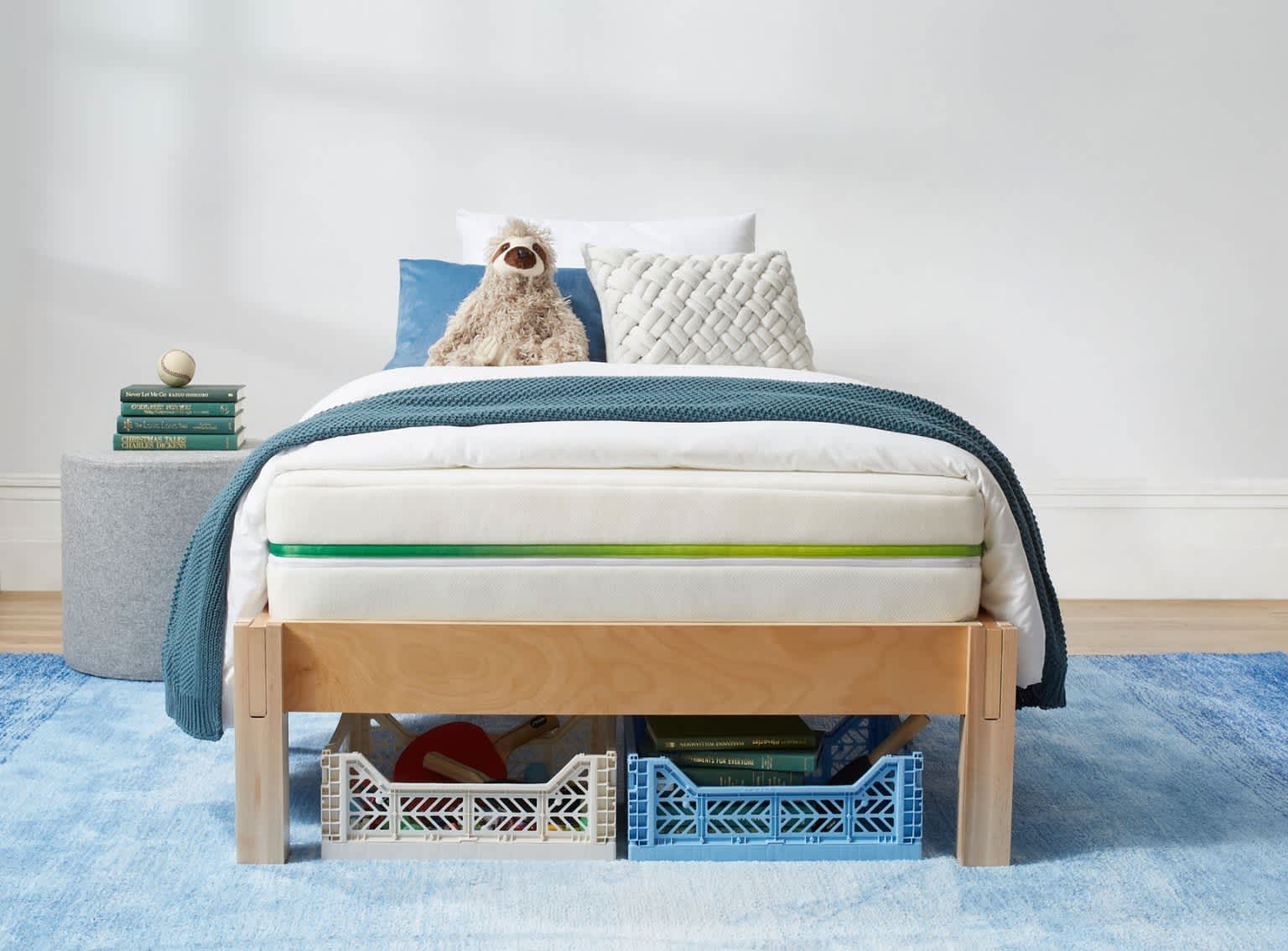
Helix Kids
A flippable hybrid designed for kids 3-12.
Key Details
- Who It’s Best For: Kids between the ages of 3 and 7 (firmer side), and kids between 8 and 12 (softer side).
- Feel: Medium firm (6) side offers light cushioning and firm, even support. The other aide is a slightly plusher medium soft (4).
- What It’s Made Of: Dense polyfoam in the firmer side’s comfort system, while the softer surface is memory foam. Shared support core of pocketed coils and water-repellent cover.
- What We Don’t Like: Kids younger than 3 and older than 13 will need a different mattress. Costs a bit more than the average child-friendly model.
Scoring & Reviews
The following ratings show how suitable this mattress is for different sleeping positions and sleeper weights. These scores are determined by how well the mattress supports and relieves pressure for each sleeper type.
In addition to the hands-on feedback from our team, we conduct a number of quantitative tests in our Test Lab. The below ratings are based on the experience of our testers.
Performance
The Helix Kids mattress has a flippable design that grows with your child, accommodating ages 3 to 12. Each side has a distinct firmness that supports the different stages of a growing body.
How It Performs
The thoughtful dual-sided design ensures the mattress will provide enough support at different stages of your child’s life. One side is aimed at children ages 3 to 7, with a medium firm (6) feel to support growing bodies. As a child reaches 8 to 12 years old, they can transition to the medium soft (4) side, which has plusher comfort layers.
Our test lab found this side offered extra contouring and pressure relief. The mattress earned high marks in our temperature neutrality tests, partly thanks to the enhanced airflow through the coil support core. So it should feel cool and comfortable even if your child tends to sleep hot.
Construction Breakdown
Both sides of the mattress feature a Tencel cover with a water-repellent finish. The finish ensures the mattress’ longevity and protects against damage from accidents or messes.
Beneath is a flammability protection layer to keep your kid safe. The support core features 5-inch pocketed coils that provide targeted support to your child’s hips and shoulders. A row of coils lines the perimeter of the mattress, which we found quite supportive when we sat on the edge.
On the side designed for 3- to 7-year-olds, the comfort system consists of dense polyfoam. Our testers found this side’s comfort layer much firmer, which helps maintain proper spinal support for younger children.
The other side, which is meant for 8 to 12 years old, features a comfort system made from gel-infused memory foam that performed well in our pressure relief tests. The gel in this layer is engineered to absorb and dissipate excess body heat.
Trial, Shipping, & Warranty
Helix ships free to all 50 states and offers families 120 nights to try out the mattress. The Helix Kids mattress also comes with a lifetime warranty.
Read More
 Read Less

Best for Young Kids: Bear Cub
Best for Young Kids
7.7/10Test Lab Score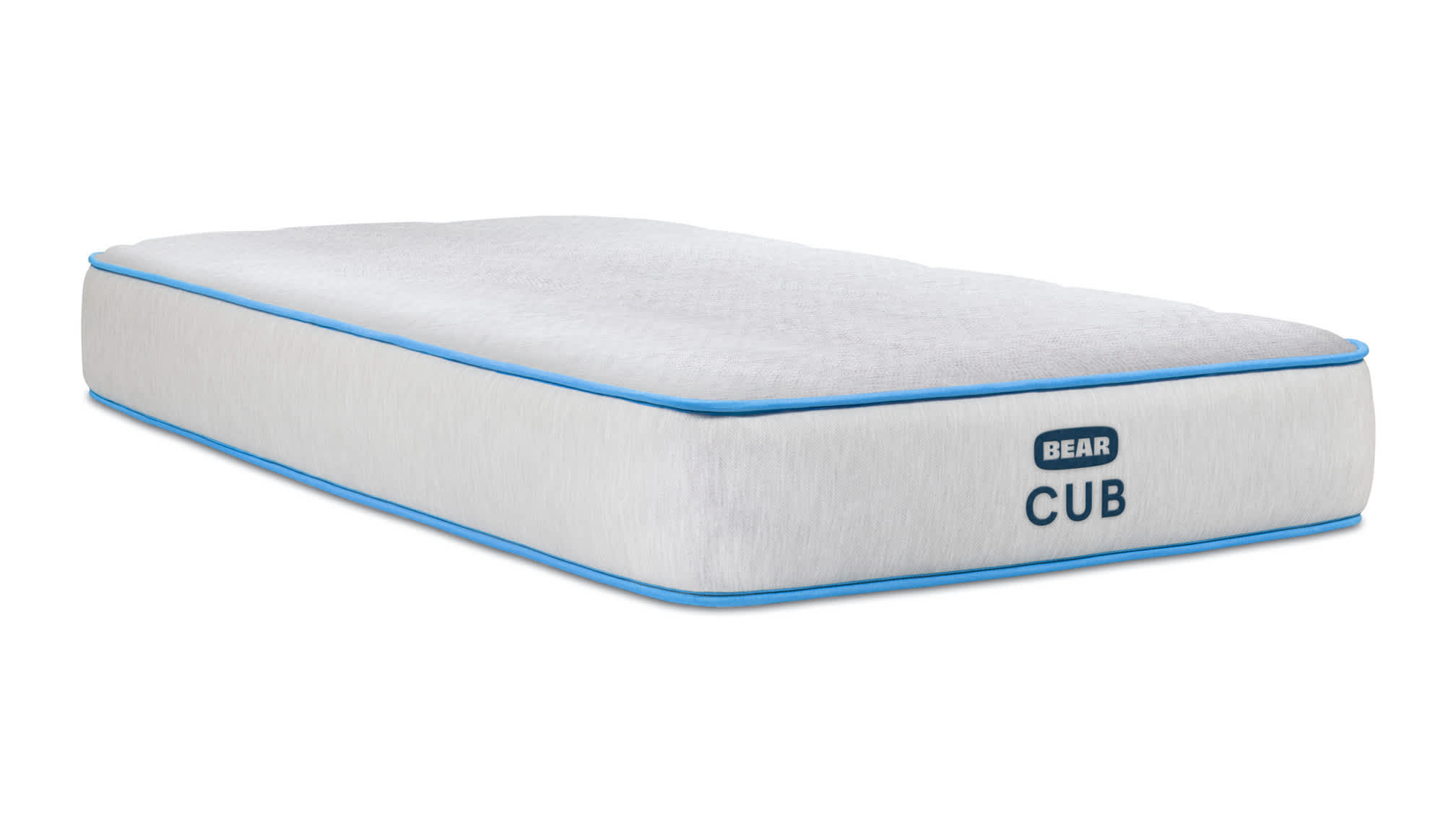
Bear Cub
A kid-friendly hybrid that’s firm and supportive.
Key Details
- Who It’s Best For: Young children and older kids who tend to run hot.
- Feel: Surface is gentle and doesn’t contour very closely. Smooth bounce when getting in and out of bed.
- What It’s Made Of: The comfort system in an adaptive memory foam layer, infused with cooling gel. Polyfoam transitional layer and strong pocketed coils in the support core.
- Feel: Strong odor can occur when the mattress is new, and some kids may find the mattress too firm.
Scoring & Reviews
The following ratings show how suitable this mattress is for different sleeping positions and sleeper weights. These scores are determined by how well the mattress supports and relieves pressure for each sleeper type.
In addition to the hands-on feedback from our team, we conduct a number of quantitative tests in our Test Lab. The below ratings are based on the experience of our testers.
Performance
Younger kids often benefit from a firmer surface to help promote healthy sleep posture. The Bear Cub has a firm (7) feel and a robust coil system that keeps the body on an even plane.
How It Performs
The Cub’s firm feel and foam hybrid construction best suited our side sleepers. The foam layers offered cushioning for sore hips and shoulders, while the coils prevented excessive sinkage. Back- and stomach-sleeping testers who weigh at least 130 pounds also found the mattress comfortable.
Temperature control was one of the mattress’ major strengths during our tests. This is largely due to the breathable cover and coil support core, which allows air to circulate through the bed’s interior.
The mattress has a responsive feel that was easy for us to move across, and the coils created a sturdy perimeter. Thanks to the supportive edges and 8.5-inch profile, kids should find it easy to get in and out of bed.
Construction Breakdown
The comfort system begins with an adaptive memory foam layer that contours to your body to relieve pressure buildup. The foam is infused with cooling gel meant to absorb and dissipate excess heat. A polyfoam transitional layer ensures your weight is evenly distributed across the mattress’ surface and acts as a buffer between your body and the coils.
Pocketed coils make up the support core, offering targeted support to the hips and shoulders to prevent uncomfortable sagging. A breathable cover made from Celliant fibers encases the mattress. Celliant is engineered to absorb your body heat, turn it into infrared energy, and confer it back to your body. This process is meant to promote muscle recovery.
Trial, Shipping, & Warranty
Bear offers free shipping to customers in the contiguous U.S. and a 120-night sleep trial. You can return it anytime after a 30-night break-in period for a full refund. A lifetime warranty backs the Bear Cub if you decide to keep it.
Read More
Read Less
Most Comfortable: Nectar Kids Memory Foam Mattress
Most Comfortable
8.1/10Test Lab Score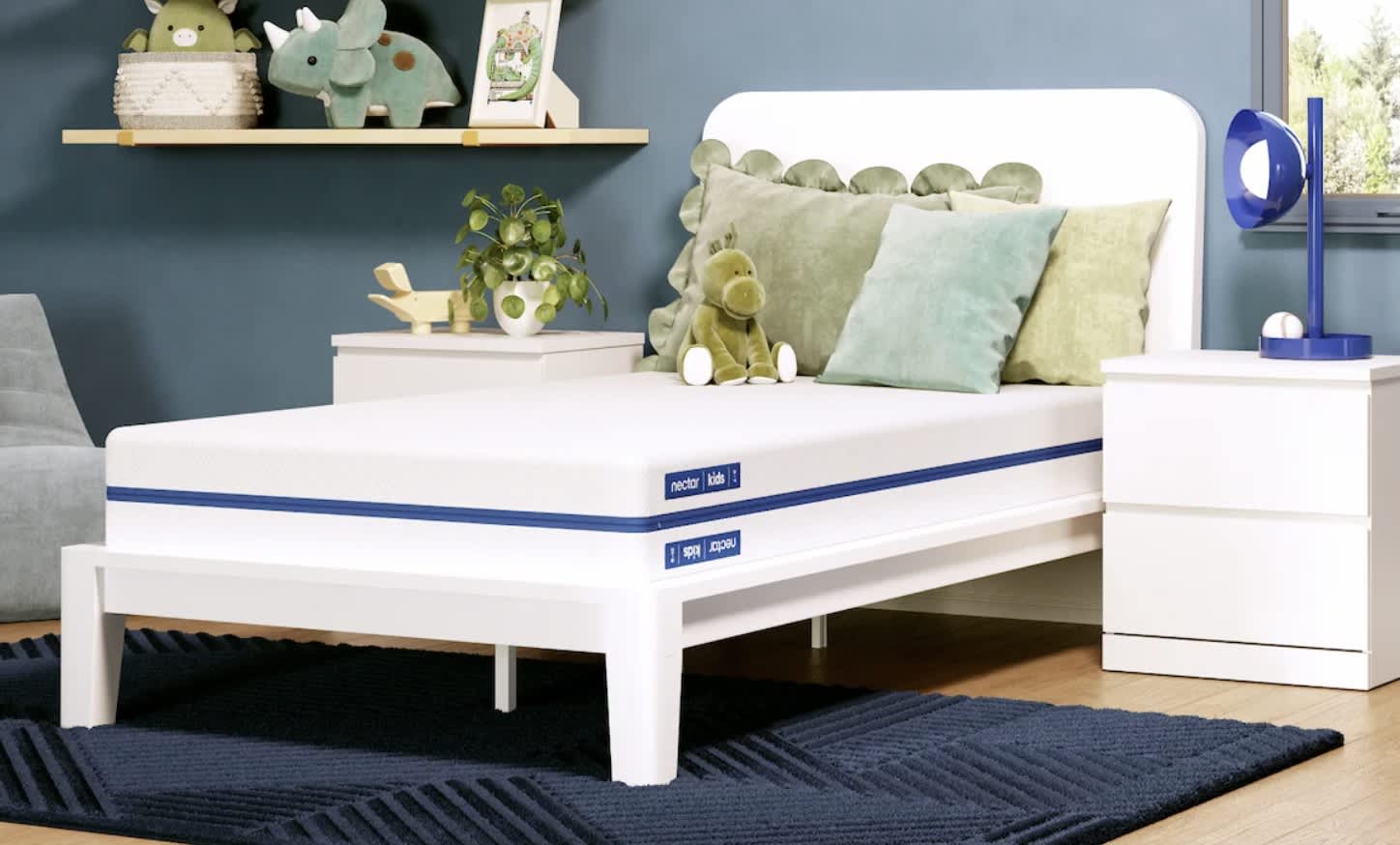
Nectar Kids Memory Foam Mattress
Key Details
- Who It’s Best For: Children between the ages of 3 and 7 (firmer side) and 8 and 12 (softer side).
- Feel: The firm (7) side contours lightly to keep the spine aligned, while the medium (5) side conforms more closely for extra cushioning.
- What It’s Made Of: Dense polyfoam on the firmer side and adaptive memory foam on the softer side, with a shared support core of high-density foam and a removable and machine-washable poly-blend cover.
- What We Don’t Like: Off-gassing odor can be fairly strong for up to 72 hours after the mattress is unboxed.
Scoring & Reviews
The following ratings show how suitable this mattress is for different sleeping positions and sleeper weights. These scores are determined by how well the mattress supports and relieves pressure for each sleeper type.
In addition to the hands-on feedback from our team, we conduct a number of quantitative tests in our Test Lab. The below ratings are based on the experience of our testers.
Performance
Comfort is subjective, but most of our testing team agrees the Nectar Kids Memory Foam Mattress stands out thanks to its flippable design and cushy all-foam construction. One side of the mattress feels firm and supportive to encourage even spinal alignment and proper growth and development for toddlers who are transitioning to a big kid bed. After a few years, you can flip over the mattress for a gentler sleep surface that feels cozy and inviting for older children.
How It Performs
Although we don’t test mattresses with children, our team found the Nectar Kids was most effective with people who weigh less than 130 pounds – a range that covers most children up to age 12. Testers between 130 and 230 pounds who sleep on their side or back also gave the mattress favorable ratings. If your child weighs more than 230 pounds, they may need a sturdier, more supportive bed.
Each side of the Nectar Kids Memory Foam Mattress has unique strengths. The firmer surface feels stronger along the perimeter, and is easier to move across. On the softer side, your child will notice deeper cushioning and a cozier overall feel.
Construction Breakdown
The Nectar Kids’ flippable, three-layer design consists of a comfort layer on each side and a shared support core made of high-density foam. The firmer side contains a layer of dense polyfoam, while the softer side features memory foam. In total, the mattress measures 8 inches thick and may be suitable for a bunk bed as long as there’s at least 5 inches of clearance between the top of the bed and the rails. The poly-blend cover is water-repellent, stain-resistant, removable, and machine-washable.
Trial, Shipping, & Warranty
Nectar offers free ground shipping to customers in the contiguous U.S. The Kids Memory Foam Mattress comes with a generous 365-night sleep trial, ensuring ample time for your child to test out the mattress and decide whether or not they like it. For those who keep the mattress, their purchase is also covered under a lifetime manufacturer’s warranty.
Read More
Read Less
Best Value: Brooklyn Bedding BB Kids Mattress
Best Value
8.2/10Test Lab Score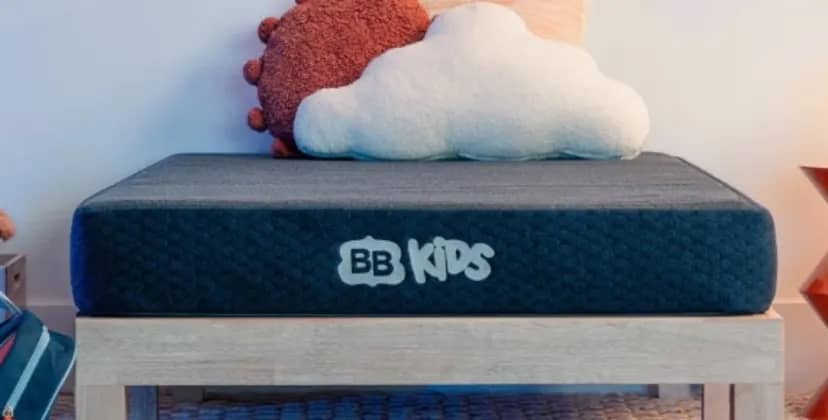
Brooklyn Bedding BB Kids Mattress
Key Details
- Who It’s Best For: Younger kids and a safe option for bunk beds.
- Feel: Firm (7) without much contouring but a strong, even support.
- What It’s Made Of: Two-layer design with memory foam over dense polyfoam and a stain-resistant cover.
- What We Don’t Like: Foam layers retain a fair amount of heat.
Scoring & Reviews
The following ratings show how suitable this mattress is for different sleeping positions and sleeper weights. These scores are determined by how well the mattress supports and relieves pressure for each sleeper type.
In addition to the hands-on feedback from our team, we conduct a number of quantitative tests in our Test Lab. The below ratings are based on the experience of our testers.
Performance
The Brooklyn Bedding Kids is a budget-friendly option for children transitioning from a crib to a standard-size mattress. Its 6-inch profile should be safe and compatible with most bunk bed based on current safety guidelines, and you can choose between twin, twin XL, and full sizes.
How It Performs
The dual-layer mattress balances cushioning on the surface with sturdy support, creating a firm (7) feel that’s conducive to your child’s growth and development. Adaptive memory foam provides light body hugging, a sensation many kids find cozy and inviting for sleep, but they shouldn’t sink too deeply into the mattress.
For a nice added touch, the cover is composed of stain- and liquid-resistant fabric. This helps ensure the mattress won’t be damaged if your child spills water or has a nighttime accident. A slim profile and lightweight construction also makes the mattress relatively easy to lift and move as needed.
Construction Breakdown
The BB Kids begins with a thin layer of memory foam, followed by 4 inches of high-density support polyfoam. As a firm mattress, the Kids only contours to a moderate extent. That said, edge support is somewhat limited. A cover made of specialty Nano Stain Terminator fabric encases the mattress.
Trial, Shipping, & Warranty
The BB Kids qualifies for free ground shipping throughout the contiguous U.S. Each order includes a 120-night trial period, and if you decide to keep the mattress, Brooklyn Bedding backs your purchase with a lifetime warranty against manufacturing defects.
Read More
Read Less
Best Organic: Birch Kids Natural Mattress
Best Organic
8.1/10Test Lab Score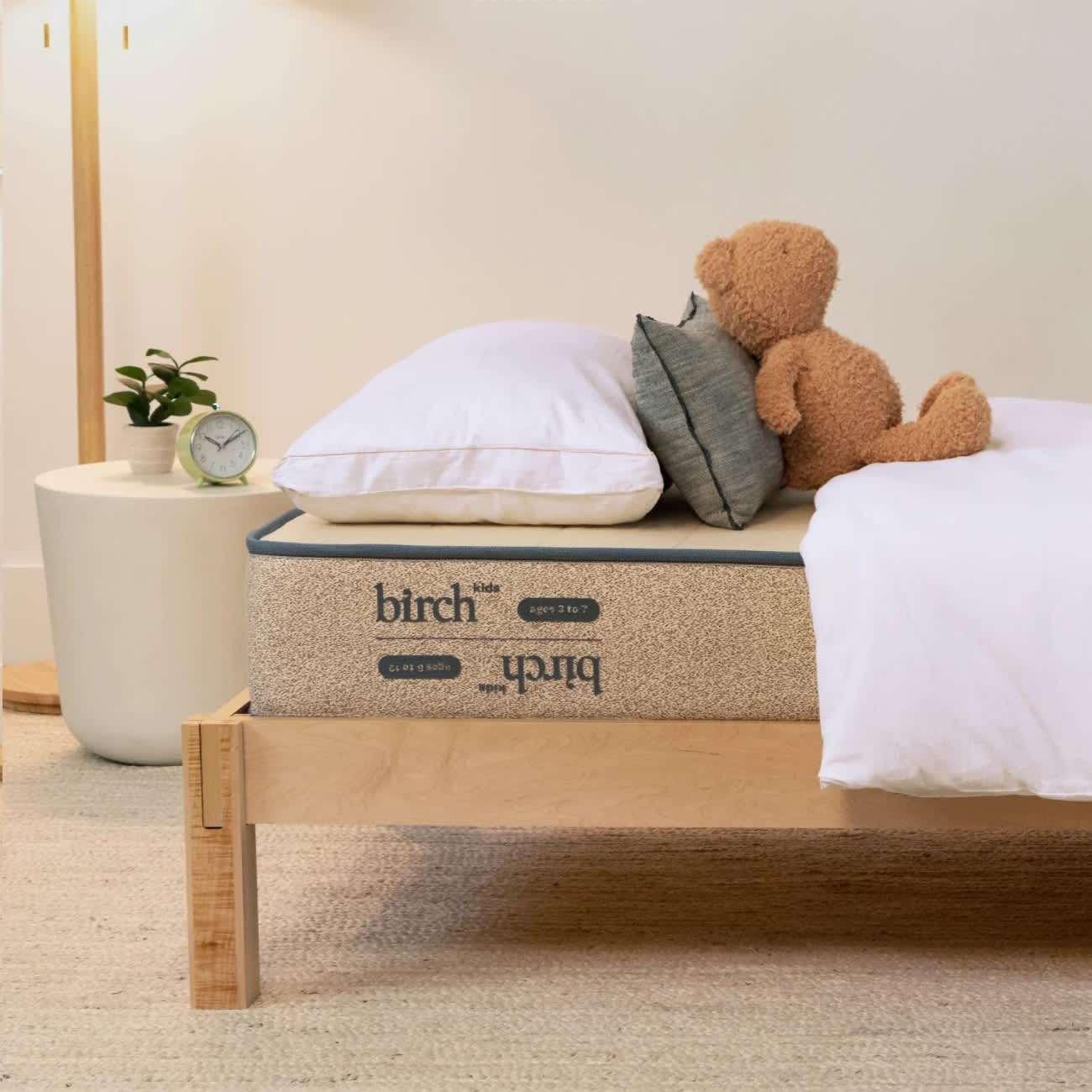
Birch Kids Natural Mattress
Key Details
- Who It’s Best For: Children between 3 and 7 (firmer side) kids 8 to 12 (softer side), as well as hot sleepers.
- Feel: Medium firm (6) and firm (7) sides. Both feel quite responsive with a light bounce. The firm side feel very supportive. The softer side conforms to a noticeable extent but doesn’t hug the body like memory foam.
- What It’s Made Of: Two layers of wool batting in the comfort system on the firm side. The softer side contains a layer of natural latex, followed by more wool batting. Shared support core of pocketed coils and a cover made of soft, breathable GOTS-certified organic cotton.
- What We Don’t Like: Fairly heavy and difficult to lift. Price is also on the expensive side.
Scoring & Reviews
The following ratings show how suitable this mattress is for different sleeping positions and sleeper weights. These scores are determined by how well the mattress supports and relieves pressure for each sleeper type.
In addition to the hands-on feedback from our team, we conduct a number of quantitative tests in our Test Lab. The below ratings are based on the experience of our testers.
Performance
The Birch Kids Natural Mattress is a bed your kids will be able to use throughout their childhood, thanks to a reversible design. Durable materials help ensure the Birch Kids won’t wear out until your child transitions to a larger bed when they reach their teenage years.
How It Performs
The Birch Kids matches the high-quality craftsmanship of Birch’s adult-friendly mattresses. Latex is naturally durable and the robust steel cools are built to last, so the mattress should perform as long as intended without showing signs of wear and tear.
Temperature control is another strong suit. A breathable cover, moisture-wicking wool layers, ventilated latex, and open coils all work together to circulate air throughout the interior and maintain a cool, comfortable surface.
Construction Breakdown
The firm (7) side meant for kids between 3 and 7 features two layers of organic wool batting. These layers are densely packed to create a supportive surface that promotes healthy growth and development for young children.
On the medium firm (6) side, a layer of natural latex rests over the wool batting. This creates a slightly softer feel without sacrificing support or responsiveness. Steel coils make up the shared support core, which stabilizes both sides in equal measure. The organic cotton cover has earned certifications from Fair Trade Cotton and the Global Organic Textile Standard.
Although the Kids Natural Mattress is more expensive than many competing models designed for children, the durable construction should prove to be a solid long-term investment.
Trial, Shipping, & Warranty
Birch also offers free ground shipping throughout the contiguous U.S. Your sleep trial runs for 120 nights. If you keep the mattress, your purchase is covered under a lifetime warranty against manufacturing defects. You can also purchase an accident protection plan that covers stains and spills.
Read More
Read Less
Best for Combination Sleepers: Avocado Eco Organic Kids Mattress
Best for Combination Sleepers
7.7/10Test Lab Score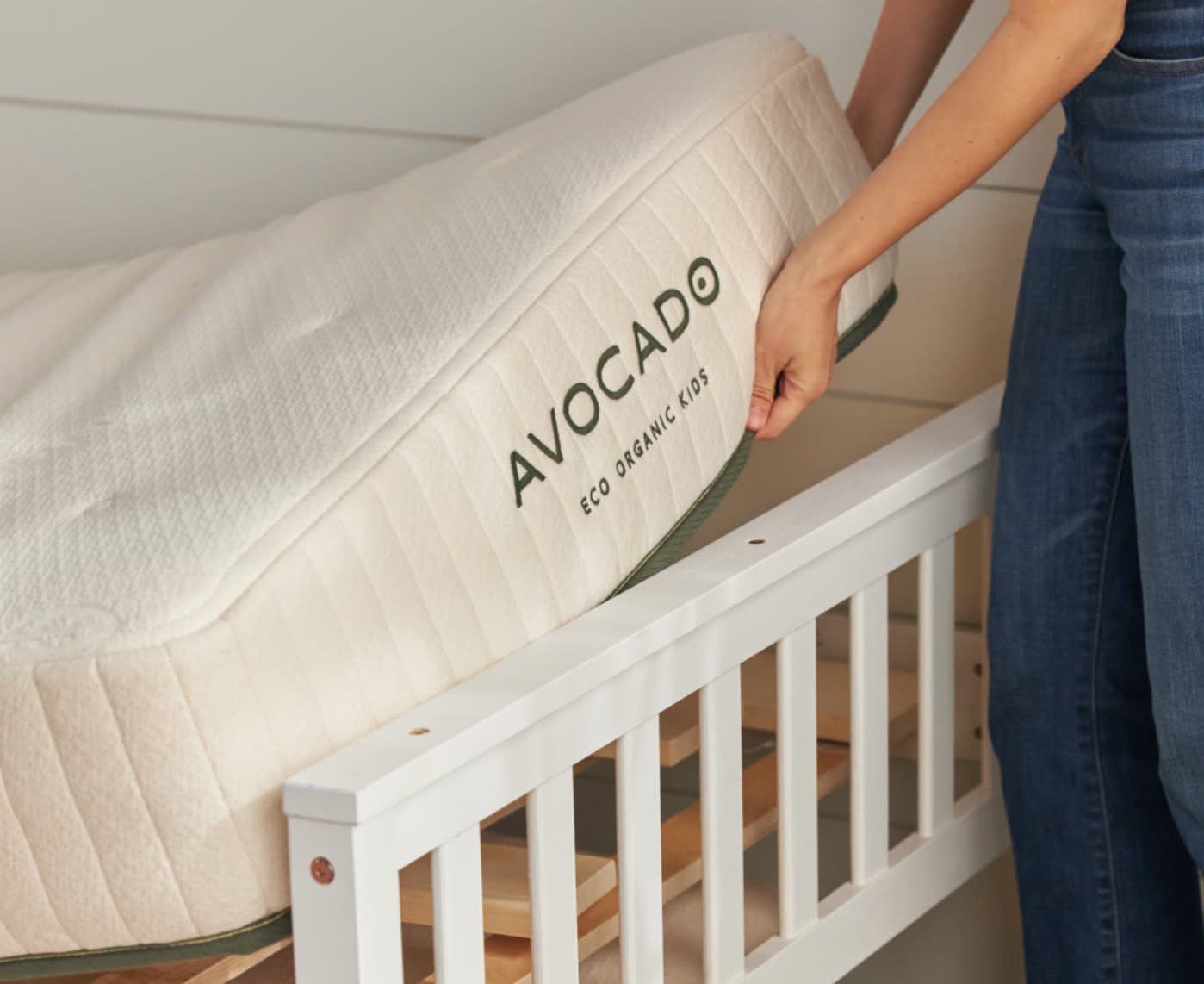
Avocado Eco Organic Kids Mattress
A durable, supportive mattress for kiddos.
Key Details
- Who It’s Best For: This mattress can accommodate children across a wide range of weights and heights, and the firm feel is intended to promote healthy growth and development.
- Feel: The Eco Organic Kids Mattress has an exceptionally springy feel, which allows your child to move across the surface without sinking too much when they get in and out of bed. The latex is ventilated and the coils promote steady air circulation, so the mattress should also keep cool.
- What It’s Made Of: A layer of organic wool beneath the cover serves as the bed’s fire barrier. The latex comfort layer is dense with light cushioning and a noticeable bounce in response to movement. Pocketed coils make up the support core, and the cover is made of organic cotton.
- What We Don’t Like: At a 7/10, this mattress might be too firm for kids with sensitive pressure points. You should also look elsewhere if your child has latex allergies.
Scoring & Reviews
The following ratings show how suitable this mattress is for different sleeping positions and sleeper weights. These scores are determined by how well the mattress supports and relieves pressure for each sleeper type.
In addition to the hands-on feedback from our team, we conduct a number of quantitative tests in our Test Lab. The below ratings are based on the experience of our testers.
Performance
If you want to buy an environmentally friendly mattress for your child, the Avocado Eco Organic Kids Mattress is a great option. The comfort layer consists of naturally springy Dunlop latex certified organic by the Global Organic Latex Standard, a leading authority for sustainably sourced latex products.
The mattress also contains an organic wool fire barrier, pocketed coils made from recycled steel, and an organic cotton cover. Additionally, Avocado holds carbon negative status. This means the company offsets more than 100% of its emissions through green manufacturing and shipping practices.
How It Performs
Like other latex hybrids we’ve tested, the Eco Organic Kids Mattress has an exceptionally springy feel. This should help your child move across the surface without sinking when they get in and out of bed or change sleep positions. The latex is ventilated, a wool fire barrier wicks away moisture, and the coils promote steady air circulation. Thanks to these components, we don’t expect bothersome heat retention to be a major issue.
The mattress has a firm (7) feel intended to promote healthy growth and development for children. Zoned coils provide extra reinforcement beneath the midsection without making the rest of the mattress feel too stiff. The coils are also thicker around the perimeter to prevent deep sinkage when your child sleeps close to the edges of their bed.
Construction Breakdown
A layer of organic wool rests beneath the cover and serves as the mattress’ fire barrier. This material and the organic cotton cover have both received certification from the Global Organic Textile Standard. The latex is produced using the Dunlop process, resulting in a dense material that lightly cushions the body. Pocketed coils make up the support core.
The Eco Organic Kids Mattress measures 7 inches thick and is available in twin, twin XL, and full sizes, so it should be compatible with most bunk beds and child-friendly bed frames. We recommend measuring any bunk bed to make sure there are at least 5 inches of clearance between the guard rails and the surface of the mattress.
Trial, Shipping, & Warranty
Avocado offers free ground shipping throughout the contiguous U.S. A complimentary copy of “My Blue Planet,” a kids book produced by Avocado, is included with each purchase. The Eco Organic Kids Mattress comes with a 100-night trial period, and parents who choose to keep it also receive a 10-year warranty.
Read More
Read Less
Best for Growing Kids: Nolah Nurture Kids
Best for Growing Kids
8.1/10Test Lab Score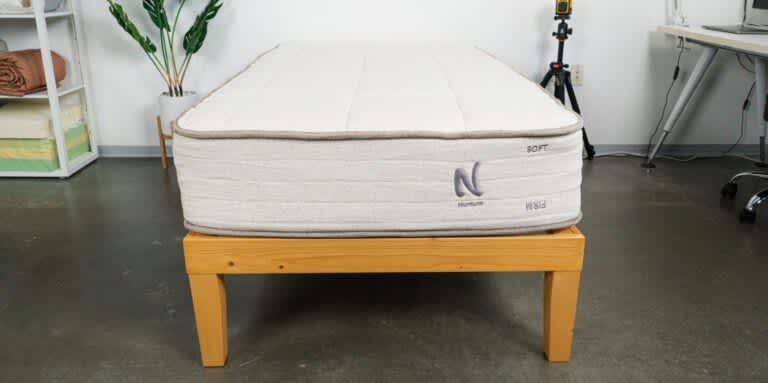
Nolah Nurture Kids
Double sided hybrid mattress that can be flipped when the kid gets older.
Key Details
- Who It’s Best For: Children under 100 pounds (softer side) and kids weighing more than that (firmer side).
- Feel: Firmer side is supportive and springy, while the softer side provides deep cushioning and contouring. Strong pushback on both sides.
- What It’s Made Of: Polyfoam comfort layers on both sides with a shared support core of multi-zone pocketed coils and breathable organic cotton cover.
- What We Don’t Like: Fairly heavy and initial odor is fairly strong.
Scoring & Reviews
The following ratings show how suitable this mattress is for different sleeping positions and sleeper weights. These scores are determined by how well the mattress supports and relieves pressure for each sleeper type.
In addition to the hands-on feedback from our team, we conduct a number of quantitative tests in our Test Lab. The below ratings are based on the experience of our testers.
Performance
The Nolah Nurture is a dual-sided foam hybrid. If you’re looking for a quality, mattress with two firmness levels in one, you may want to consider the Nolah.
How It Performs
The Nolah has a flippable design — we rate one side as soft (3) and the other as firm (7). Children under 130 pounds may prefer the softer side, while kids weighing at least 130 pounds may find the firmer side more comfortable.
Across weight categories, side and back sleepers on our test team benefited from the Nolah’s pressure-relieving foam comfort layers and zoned coil design. . We noticed that the breathable materials and enhanced airflow through the coil support core kept the surface cool.
Construction Breakdown
The mattress is encased in a cover made from GOTS-certified organic cotton, a naturally breathable material that kept the surface cool to the touch during our tests. Next is a breathable wool layer that acts as a natural fire retardant. The comfort system features 2 inches of adaptive foam, which provided slight contouring to relieve pressure buildup during our pressure tests.
The support core is made from 6-inch pocketed coils, strategically zoned to support the hips and shoulders. A layer of firmer foam rests under the coils for extra stability and durability. If the top surface is too soft for your child, simply flip over the mattress and they can sleep on the firmer foam layer instead.
Trial, Shipping, & Warranty
Nolah offers free shipping to the contiguous U.S. and a 120-night sleep trial. Nurture 10 purchases come with a lifetime warranty.
Read More
Read Less
Best for Spinal Alignment: Saatva Youth
Best for Spinal Alignment
8.4/10Test Lab Score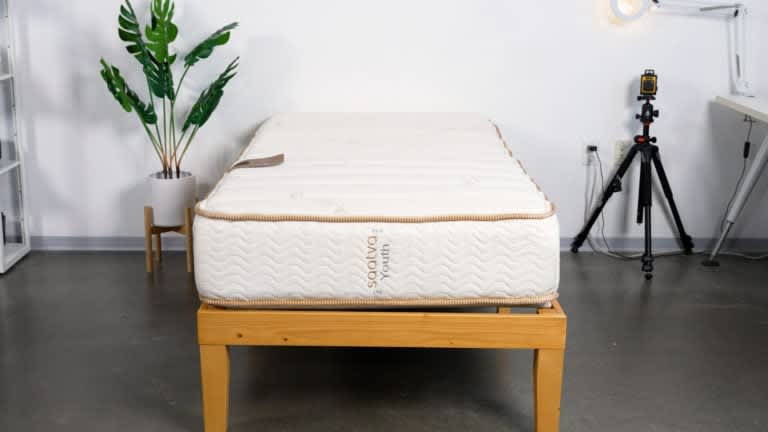
Saatva Youth
A reversible hybrid meant for growing children.
Key Details
- Who It’s Best For: Younger kids (firmer side) and older children (softer side).
- Feel: Medium (5) side offers deeper cushioning than firm (7) side. Both feel supportive and springy.
- What It’s Made Of: Firmer surface is egg-crate polyfoam, while the softer side’s foam layer is divided into five firmness zones. Thick, hourglass coils make up the shared support core.
- What We Don’t Like: Expensive and returns during the sleep trial incur an additional fee.
Scoring & Reviews
The following ratings show how suitable this mattress is for different sleeping positions and sleeper weights. These scores are determined by how well the mattress supports and relieves pressure for each sleeper type.
In addition to the hands-on feedback from our team, we conduct a number of quantitative tests in our Test Lab. The below ratings are based on the experience of our testers.
Performance
The Saatva Youth is a reversible innerspring mattress designed to accommodate children’s changing mattress needs as they grow older. Since one side is firmer, you can flip the mattress once your child grows too heavy to be supported by the softer side.
How It Performs
The mattress performed well in our temperature neutrality tests since the coil layer allows a substantial amount of airflow throughout the mattress. This ensures your child won’t sleep too hot throughout the night.
The thick construction of the coils also gives this bed great edge support, preventing kids from rolling off the bed in the middle of the night. The strong edges and low profile also make it easy for kids to get in and out of bed on their own. The quality of materials ensures a durable mattress that should last into your child’s teenage years.
Construction Breakdown
The softer side of the mattress features a zoned polyfoam comfort layer that provided extra support to our testers’ backs and hips while conforming closer to the head, neck, and shoulders.
The comfort layer on the firm side is made of higher-density convoluted polyfoam, which felt more supportive overall. In between these two sides is a support core of thick bonnell coils. The cover is composed of breathable organic cotton.
Trial, Shipping, & Warranty
Saatva offers free White Glove delivery, including in-home assembly and old mattress removal. They also offers a 365-night sleep trial, and if you decide to keep it, you’re covered by a lifetime warranty.
Read More
Read Less
Best for Pressure Relief: Leesa Kids Mattress
Best for Pressure Relief
7.5/10Test Lab Score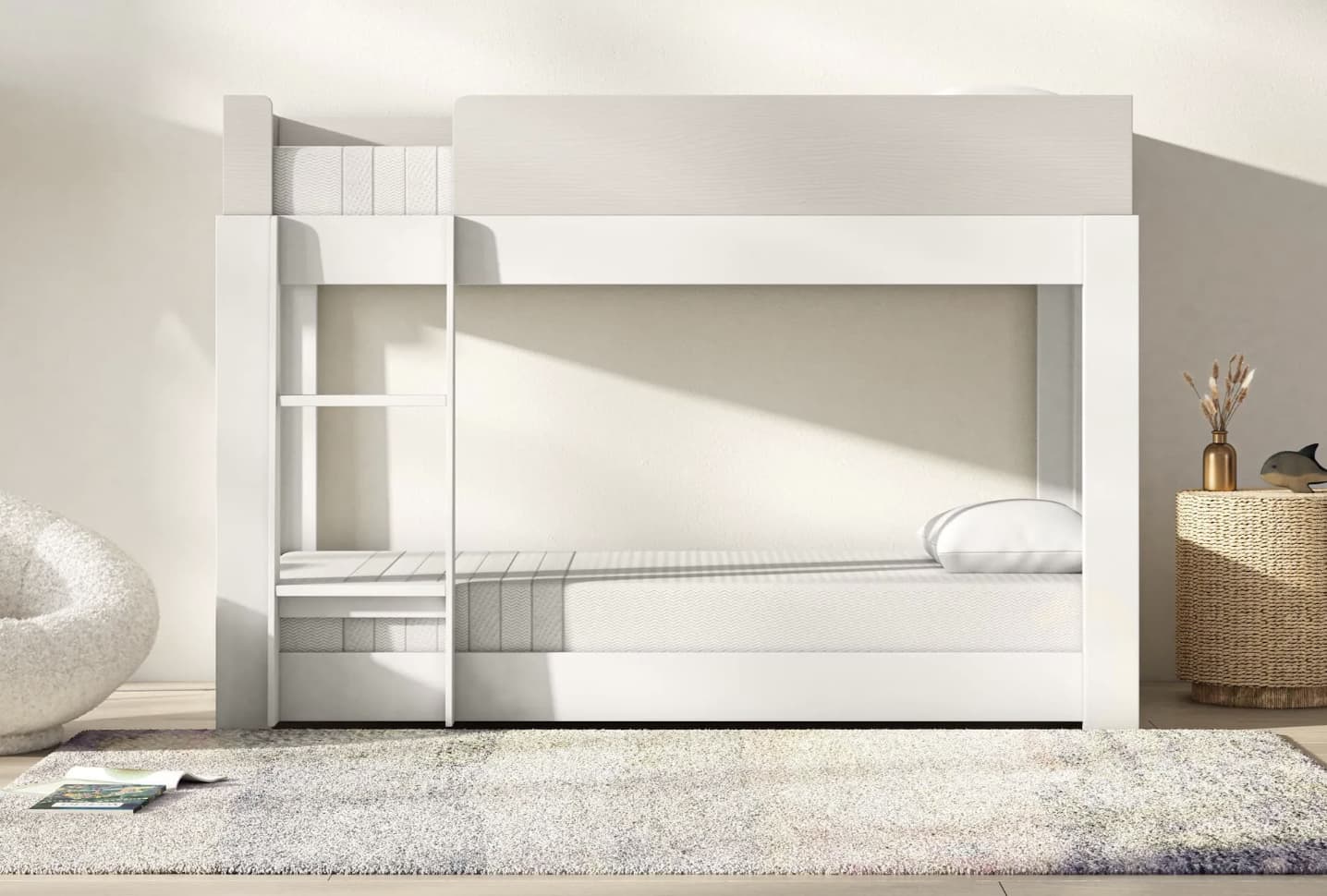
Leesa Kids Mattress
Key Details
- Who It’s Best For: Children and preteens who sleep hot.
- Feel: Noticeable cushioning on the surface, but strong overall stability and a breathable cover.
- What It’s Made Of: Three-layer design with open-cell memory foam, as well as transitional and support layers composed of dense polyfoam.
- What We Don’t Like: Might require specialty sheets with a lower pocket depth. Might also produce some unpleasant odors for the first few nights after unboxing.
Scoring & Reviews
The following ratings show how suitable this mattress is for different sleeping positions and sleeper weights. These scores are determined by how well the mattress supports and relieves pressure for each sleeper type.
In addition to the hands-on feedback from our team, we conduct a number of quantitative tests in our Test Lab. The below ratings are based on the experience of our testers.
Performance
The Leesa Kids Mattress is designed specifically for children and preteens. Our testers found that the medium firm (6) feel limits sinkage, which should keep your child’s body on an even plane.
How It Performs
During our tests, the Leesa Kids Mattress performed very well with temperature control — an area where many all-foam models tend to earn subpar ratings. The open-cell memory foam coupled with a breathable cover let heat dissipate rather than build up along the surface.
The balanced medium firm feel should also prevent young kids from sinking too much or feeling trapped by the mattress. A low 7-inch profile allows the mattress to rest safely in most bunk beds at least 5 inches below the side rails, per current safety guidelines.
Construction Breakdown
The Kids Mattress features a three-layer design that begins with a top layer of open-cell memory foam. This material features small air capsules engineered to promote circulation and prevent bothersome heat absorption.
The transitional and support layers are composed of polyfoam that we found balances support and contouring. The base layer is much denser to provide adequate reinforcement for your child’s growing body. A knit polyester cover encases the entire mattress.
Trial, Shipping, & Warranty
Shipping is free to all 50 states. Your order includes a 120-night sleep trial, and if you decide to keep it, you’ll receive a lifetime warranty against structural defects.
Read More
Read Less
Best Cooling: SweetNight CoolNest Hybrid
Best Cooling
7.9/10Test Lab Score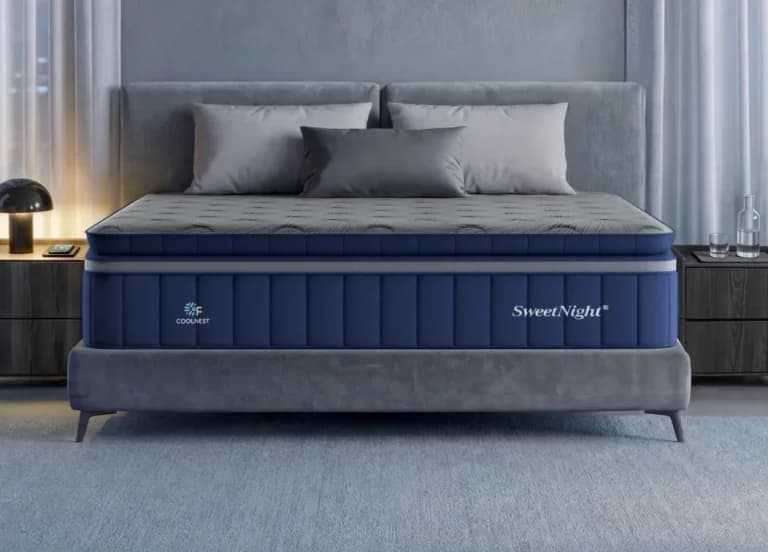
SweetNight CoolNest Hybrid
Key Details
- Who It’s Best For: Older kids and teens who experience aches, soreness, and pressure buildup as part of their natural growing pains.
- Feel: Available in medium soft (4), medium (5), and medium firm (6) designs — each with a unique thickness profile.
- What It’s Made Of: Comfort layers of high-resiliency polyfoam, memory foam, and transitional foam over pocketed coils with perimeter reinforcement. You can choose from 12-inch (6), 14-inch (5), and 16-inch (4) profiles.
- What We Don’t Like: The mattress is not available in twin or twin XL, two of the most common sizes for kid-friendly models, and the profile is too thick for bunkbed use.
Scoring & Reviews
The following ratings show how suitable this mattress is for different sleeping positions and sleeper weights. These scores are determined by how well the mattress supports and relieves pressure for each sleeper type.
In addition to the hands-on feedback from our team, we conduct a number of quantitative tests in our Test Lab. The below ratings are based on the experience of our testers.
Performance
When we talk about kids’ mattresses, the needs of preteens and teenagers often get overlooked. Children ages 11 to 17 experience growing pains that can make them feel sore or stiff when they wake up in the morning, and a plush mattress like the SweetNight CoolNest Hybrid can provide the soothing sleep surface they need. This foam-on-coil mattress is available in three profiles, each with a different firmness level, and the sticker price is quite budget-friendly compared to the competition.
How It Performs
Since the SweetNight CoolNest Hybrid is available in full, queen, king, and California king sizes, it is best suited for older kids and teens who won’t find a larger sleep surface too expansive or overwhelming. The medium soft (4) and medium (5) designs are ideal for side and back sleepers under 130 pounds, while the medium firm (6) offers enough support for kids who use these sleep positions and weigh 130 to 230 pounds.
Pressure relief is a defining strength of this mattress. Thanks to a deep comfort system with four individual foam layers, the CoolNest Hybrid performs well where other coil beds fall short. Most children won’t sink too much, though our testers weighing more than 230 pounds noted some deep compression when moving on the surface and sitting along the perimeter.
The CoolNest Hybrid’s first layer consists of high-resiliency polyfoam, an adaptive material that gives the mattress some surface-level plushness Two memory foam layers build on the cushy feel. Your child will feel these layers conforming closely as their body sinks into the bed, and this deep cradle helps promote even alignment and prevent pressure from building on the spine. Transitional foam rounds out the comfort system, creating a gentle buffer between your body and the support core.
Pocketed coils with a reinforced perimeter are meant to stabilize the entire mattress. However, most kids will still sink to a noticeable degree. A breathable, knit polyester cover encases the mattress.
Trial, Shipping, & Warranty
The CoolNest Hybrid’s sticker price falls in line with other budget mattresses on the market, and SweetNight further sweetens the deal with free ground shipping throughout the contiguous U.S. Your order includes a sleep trial that runs for 100 nights, along with a 10-year warranty against manufacturing defects.
Read More
Read Less
Watch Video: We Tested the Best Kid Mattresses – Here Are Our Favorites
Watch the video below for some tips on what to look for when shopping for kid’s mattresses.
Signs Your Child May Be in Need of a New Mattress
Deciding when it’s time to buy your child a new mattress can be a bit of a puzzle. Fortunately, a few telltale signs can help you feel confident when it’s time for an upgrade.
- Your child has aged out of their current bed: Just as kids grow out of shoes and clothes, it’s normal for kids to outgrow their mattress over time. As they get older, kids will need a new mattress when they transition from a crib to a toddler bed, from a toddler bed to a “big kid” bed, and from a childhood bed to one suited for a pre-teen or teen.
- Your child is no longer comfortable: If your child seems uncomfortable or you notice that their feet are beginning to dangle off the foot of the bed, it’s likely that they’ve outgrown their mattress. A mattress designed for a younger child may not offer the support needed for an older child or pre-teen.
- There is noticeable wear and tear: Your kid’s mattress should be upgraded if you can see any visible damage, hear creaky springs, or notice sagging. Remember that an overly worn mattress can impair the quality of your child’s sleep.
What Do Kids Need From Their Mattress?
Kids need a mattress that caters to their unique needs, preferences, and evolving growth patterns. The right mattress provides foundational support for their posture and physical development, ensuring they wake up refreshed and ready for new adventures each day.
Room to Grow
Perhaps the most important consideration when choosing your kids’ mattress is size. Just like their favorite pair of shoes, your child’s mattress needs room to accommodate their growth. Toddlers may fit snugly in a twin-size, but preteens often benefit from larger full or queen sizes. Anticipate growth spurts and whether they will share the bed with siblings. Also, consider mattress height, especially for bunk beds and uniquely sized bed frames.
| Size | Dimensions |
|---|---|
| Twin | 38″ x 75″ |
| Twin XL | 38″ x 80″ |
| Full | 54″ x 75″ |
| Full XL | 54″ x 80″ |
| Queen | 60″ x 80″ |
Support for Changing Bodies
Support in a mattress means it can adequately bear your child’s weight, adapt to the contours of their body, and maintain spinal alignment. As kids grow, and their weight and body changes, they will need different levels of support. Larger children may prefer a firmer bed that supports their body weight, while smaller children may like a softer bed that they can sink into.
Additionally, your child’s preferred sleeping position plays a role in choosing the right mattress. Side sleepers tend to feel more comfortable on softer mattresses that cushion their hips and shoulders, while those who sleep on their backs or stomachs might favor firmer options to ensure their midsections don’t sink too much.
Comfort for Evolving Tastes
Comfort is different for everyone and differs from support. While younger kids often prefer a softer mattress, adolescents tend to lean towards a firmer feel. Since comfort isn’t a one-size-fits-all concept, it can help to talk to your kids about what kind of bed they’d like. Recognizing your child’s thoughts and preferences can help to ensure that they feel comfortable in their new bed.
“When buying mattresses for my kids, my biggest goal is helping them sleep through the night. Beds with cooling properties are great, to avoid overheating. Plush and cozy models were a good fit in their younger years, but I’ve opted for firmer beds as they’ve gotten older — to make sure their growing bodies are fully supported.” – Mina Hochberg, Senior Product Manager
What to Look for In the Best Mattress for Kids
When shopping for your child’s next mattress, it’s essential to consider the qualities in a bed that matter most to a kid.
Mattress Type
Just like mattresses for adults, kids mattresses come in a wide variety of styles. The most common types of kids mattress include foam, hybrid, and latex models. Each mattress type offers unique benefits tailored to children’s needs.
Foam Mattresses: These mattresses are often chosen for their cozy feel, contouring, and pressure relief. They usually have a lower price tag than other types, but may lack durability and can sometimes retain heat.
Hybrid Mattresses: Combining foam with coils, hybrids offer both comfort and support, making them versatile for growing kids. They usually provide better temperature regulation but can be pricier.
Latex Mattresses: Durable and responsive, latex beds offer excellent support and are available in eco-friendly models. They can be more expensive, which might not be ideal for very young children who will quickly outgrow their mattress.
Allergies, Sensitivities, and Off-Gassing
When shopping for a child’s mattress, it’s important to consider any allergies and sensitivities your child has. Some materials, like latex and certain types of synthetic foams, can irritate allergies or sensitive skin. It can be helpful to research and opt for hypoallergenic materials.
Off-gassing refers to the release of volatile organic compounds (VOCs) from new mattresses, which can cause a temporary odor and sometimes affect those with sensitivities. Prioritizing natural or certified materials can minimize off-gassing and provide a safer sleep environment.
Look for Mattress Certifications
Finding a mattress with certain certifications can help to ensure that a mattress has been tested for safety.
- CertiPUR-US: This certification ensures the foam used in mattresses is free from harmful chemicals and has low VOC emissions.
- GREENGUARD: Recognized for products that maintain low chemical emissions, this standard ensures that a mattress protects indoor air quality.
- Global Organic Textile Standard (GOTS): GOTS certification indicates that the textiles used in the mattress are organic and have met specific environmental and social standards.
- Global Organic Latex Standard (GOLS): This certification confirms that the latex in a mattress is organic and produced sustainably, considering both environmental and worker safety.
Price and Durability
Children’s mattresses come in a wide price range, with factors such as materials, size, and brand influencing the cost. When choosing a mattress, it can help to consider its durability and lifespan because a long-lasting mattress offers greater value over time.
Because kids grow up quickly, consider a mattress that can accommodate several growth spurts. Investing in a durable and slightly larger mattress means not having to replace it as frequently. For instance, while a bed for a 3-year-old might soon be outgrown, a well-chosen mattress for a 10-year-old could potentially see them through to their late teens and into adulthood.
Tips for Protecting Your Child’s Mattress
Don’t forget that you can also increase the lifespan of a mattress through proper care. Regular cleaning, using mattress protectors, and occasionally rotating or flipping the mattress can prolong its lifespan, ensuring you get the most out of a new mattress.
Temperature Control
Whether from active dreams, summer heat, or the occasional fever, children often benefit from sleeping on a mattress that doesn’t retain too much heat. Look for features like gel-infused foams, open-cell designs, or moisture-wicking covers to tell that a mattress is designed to stay cool.
Trials, Returns, and Warranties
Trial periods, also called sleep trials, allow you to use a bed before deciding whether to keep it. Choosing a mattress with a generous trial period gives you and your child the chance to make sure a new bed is the right fit. Flexible return policies and warranties can also provide parents with peace of mind, knowing that a bed can be sent back for things like manufacturing defects and excessive wear.
How We Test: Your Comfort Is Our Science
Our industry-leading product testing team cares deeply about improving your sleep. Having a holistic understanding of a mattress’s role as part of a sleep system is paramount to our testing process. Since a bed’s comfort and feel depend largely on body weight and sleeping position, our testing team represents a wide range of body types, sleep positions, and comfort preferences.
In our Seattle-based Test Lab, we use an objective, hands-on process to evaluate mattresses across performance categories. The following are the key guidelines that inform our performance ratings. Our ultimate goal is to ensure you have all the information you need to make the best purchase decision for you.
Construction analysis: Our ratings system is grounded in construction. Each mattress rating is derived at the intersection of quality, value, and versatility across a range of sleepers. We look at the bed’s price point, materials, firmness options, comfort and support systems, cooling technology, as well as brand reputation, and then we perform a detailed analysis that measures performance across six different categories to arrive at an overall score.
Quantitative product testing: During these hands-on lab tests, our team uses various tools and technology to evaluate a bed’s performance against motion isolation, pressure relief, temperature control, ease of movement, edge support, and potential for odor emissions. We use the outcomes from these tests to calculate a score for each category.
Field testing: Our field testers sleep on mattresses and other sleep products, like pillows, sheets, and mattress toppers, in their own bedrooms. After weeks of at-home testing, each field tester provides a detailed analysis of how the mattress performs, including what they like and dislike about the bed.
User feedback: Observations from mattress owners and users outside our team are invaluable to our research. We draw insight from surveys, sleep stories, and customer reviews to extract themes, fine-tune our ratings, and better understand how each product performs over time in a real-world setting.
So how did we pick the best mattress for kids?
To compile our list of the best mattresses for kids, we focused on support, perimeter stability, and other qualities associated with healthy sleep and development for children. Although we evaluate mattresses for kids and adults using the same performance criteria, we paid special attention to feedback from testers weighing less than 130 pounds — the most common weight range for young children and preteens. Other factors that played a role in our selection process included the use of waterproof materials, size availability, bunk bed compatibility, and cost.
How We Determine Our Overall Scores


To determine a mattress’s overall score, we assign weighted percentages to performance categories based on how important they are to the individual sleep experience. For instance, areas like pressure relief and temperature control tend to matter more to people than something like off-gassing, and because more people sleep on their side and back than on their stomach, we weigh those positions more heavily
Performance Categories
Motion Isolation
This criteria alludes to the amount of motion a mattress absorbs when a sleeper moves on the surface. We use two testers lying side by side to evaluate motion isolation, who each feel for transfer while the other person moves on the mattress.
Temperature Control
To determine how well a mattress regulates temperature, we perform temperature tests and look closely at its materials and construction. Many mattresses are designed with cooling components meant to reduce heat retention.
Pressure Relief
A bed with strong pressure relief excels at preventing pressure from building up in areas like the shoulders and hips. Beds with even contouring and weight distribution are top performers when it comes to pressure relief.
Off-Gassing
A mattress in a box may release unpleasant chemical odors for a short period after you’ve unboxed it. The initial smell may be strong but typically fades within 2 or 3 days.
Ease of Movement
This criteria reflects how easily a sleeper can move across a bed’s surface. Responsive surfaces made of latex typically perform better than foam surfaces, which can inhibit movement.
Edge Support
We perform sit tests along a bed’s perimeter to measure how well the edges push back against weight. Mattresses with strong edge support have minimal sagging when sleepers sit on or lie close to the perimeter.
Dive Deeper – Mattress Guides by Sleeper Type
For more help deciding which mattress is right for your specific needs, check out the guides below.
Best Mattress by Sleeper Type

Still have questions?
Our product experts have extensive experience testing just about every sleep product on the market.
Send an email to AskAnExpert@sleepfoundation.org with your questions and we’ll help you find exactly what you’re looking for.
Rachel combines a background in health journalism with hands-on experience testing sleep products. In her time at Sleep Foundation, she's researched and evaluated mattresses, pillows, bedding, and sleep tech to help readers find the products best suited to their sleep needs. Outside of work, Rachel enjoys hiking and spending time outdoors with her kids.
As a board-certified sleep medicine physician with over 20 years of clinical experience, Dr. Adavadkar is an expert in diagnosing and treating sleep disorders in both children and adults, as well as addressing sleep issues experienced by veterans. Dr. Adavadkar is a member of the Sleep Foundation Medical Advisory Board.
Learn more about our medical advisory board