When you buy through our links, we may earn a commission. Products or services may be offered by an affiliated entity. Learn more.
How to Stop Grinding Teeth at Night


At a Glance
To reduce nighttime teeth grinding (bruxism):
- Wear a custom-fitted mouthguard. Dental splints and mandibular advancement devices are two of the most common.
- Manage stress with relaxation techniques like deep breathing or meditation.
- Try jaw exercises, physical therapy, or gentle massage.
- Talk to your doctor or dentist about treatment options, including medications like muscle relaxants and Botox injections.
Nighttime teeth grinding, also known as sleep bruxism, often goes unnoticed—until the symptoms start to show. During sleep, people are generally unaware that they’re grinding their teeth and can apply substantial pressure — up to 250 pounds of force — that can wear down the teeth, cause jaw and neck pain, and induce headaches . It’s most common in children, adolescents, and young adults, but it can affect people of any age.
While there’s no cure to completely stop teeth grinding , treatment can reduce its frequency, decrease its impact, and relieve symptoms . In addition, home-care tips can make it easier to cope with sleep bruxism.
Mouthguards
Wearing a mouthguard at night is one of the most common treatments for teeth grinding during sleep. While mouthguards usually don’t stop clenching or grinding, they can protect the teeth and reduce other symptoms, such as jaw pain.
Not all mouthguards work in the same way, and there are two main types: dental splints and mandibular advancement devices (MADs).
Dental Splints
Also known as a night guard, bite plate, or bite guard, a dental splint is worn during sleep to combat teeth grinding. The mouthpiece provides a barrier designed to minimize tooth damage from grinding. Many people who use a dental splint find that it also reduces other symptoms, like headaches or mouth and jaw pain.
There are different shapes and sizes of dental splints. They may cover all or only some of the teeth, and they can be hard or soft. Mouthguards can be custom-fitted by a dentist, but they’re also available over the counter. It’s best to check with a dentist about the fit of any mouthguard. The right fit helps ensure the mouthguard doesn’t alter your bite pattern.
Although often beneficial, a dental splint may become less effective over time and may need to be replaced. People with sleep apnea should talk with their doctor or dentist before using a dental splint to prevent breathing disruptions during sleep.
Mandibular Advancement Devices (MADs)
Mandibular advancement devices (MADs) are best known for their use in reducing snoring and treating mild obstructive sleep apnea . These devices are designed to hold the lower jaw forward, which helps keep the airway open during sleep. MADs also cover some or all of the teeth, which can reduce the impact of teeth grinding at night.
Most people find dental splints more comfortable to use than MADs. As a result, MADs are typically used by people who grind their teeth and also have obstructive sleep apnea. Like dental splints, MADs come in various types, and the best results usually come from MADs that are custom-molded by a dentist. A dentist should also check the fit of over-the-counter MAD devices.
Is Your Bruxism a Problem?
Bruxism sometimes occurs alongside other issues such as sleep apnea. Answer three questions to better understand your sleep.
Stress Reduction
Research suggests that stress and anxiety are common contributors to teeth grinding . Bruxism can vary over time and even from night to night, and for some people, it seems to get worse when experiencing high levels of stress. For that reason, stress reduction may help decrease teeth grinding.
Research suggests that stress plays a bigger role in daytime teeth grinding, meaning stress reduction techniques aren’t proven to cut down on sleep bruxism. Nevertheless, taking steps to relieve stress may still be worthwhile, especially because limiting stress can enhance sleep and provide other health benefits.
Relaxation Techniques
Relaxation techniques are a primary way to counteract stress . Using relaxation methods can be a big part of sleep hygiene, and getting better sleep can empower you to respond to stress in a healthier way . They can also be helpful if you grind or clench your teeth during the day. Try a few different approaches to see what works best for you.
- Deep breathing: This involves slow, controlled inhalation and exhalation to ease tension in the mind and body.
- Meditation: Meditation is a practice that involves focusing the mind and eliminating distractions to achieve a state of calm.
- Progressive relaxation: This technique involves gradually tightening and releasing muscles throughout the body.
- Biofeedback: Biofeedback uses sensors to monitor physical reactions in the body, allowing you to optimize your approach to relaxation. Some early research is studying nighttime biofeedback for teeth grinding.
- Yoga or tai chi: These are physical practices and postures that can facilitate both mental and physical relaxation.
Behavior Change
Certain types of behavior changes can accompany stress reduction to decrease teeth grinding, especially when you’re awake. This may ultimately help to reduce sleep bruxism as well.
Teeth clenching is habitual and often occurs without even thinking about it. Despite this,
try as much as possible to keep your mouth and jaw in a resting position during the day . In addition, see if you can figure out when you’re prone to grinding your teeth, such as when you’re trying to focus or when dealing with stress.
With that awareness, you can try to relax your jaw during those moments. It may also help to write yourself a note to remember to check whether you’re tensing your jaw muscles. Over time, you can work to adapt your behavior to reduce or eliminate clenching and grinding.

Lifestyle Changes
Different types of lifestyle changes can help reduce sleep bruxism and address some of its symptoms. Improving sleep hygiene promotes better sleep, which may cause fewer episodes of nighttime teeth grinding. In addition, certain food choices can decrease jaw and mouth pain related to sleep bruxism.
Sleep Hygiene Improvements
Better sleep often means less teeth grinding at night, and focusing on sleep hygiene is one of the main ways to improve sleep quantity and quality . In this way, focusing on better sleep may be a key part of how to naturally stop teeth grinding during sleep.
Experts believe that sleep bruxism begins during extremely brief awakenings from sleep. These awakenings are so brief that people usually aren’t aware of them, yet they can trigger an episode of teeth grinding. Getting higher-quality sleep may contribute to fewer of these awakenings, and, as a result, fewer periods of teeth grinding.
Improving sleep hygiene involves making changes to your bedroom environment and your sleep-related habits. Some practical tips include:
- Making your bedroom as dark and quiet as possible
- Setting your bedroom thermostat to a cool, comfortable temperature
- Sticking to consistent sleep and wake times
- Creating a relaxing bedtime routine
- Limiting screen time before bed
- Avoiding caffeine and alcohol in the evening
- Keeping daytime naps short and early in the afternoon
Reducing Mouth and Jaw Pain
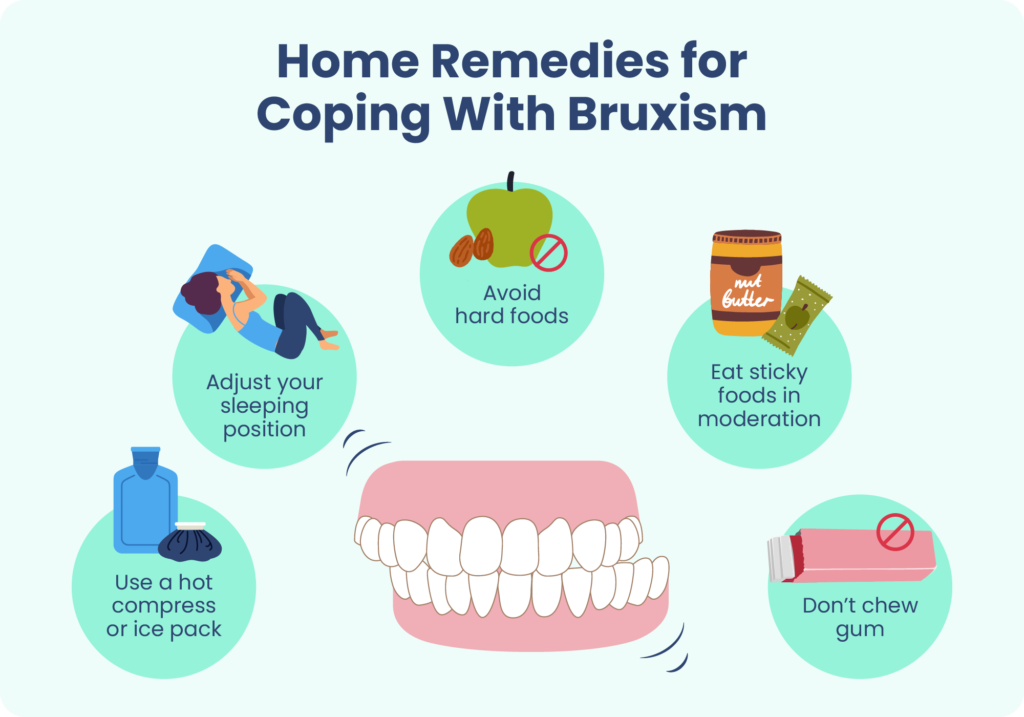
Several self-care tips and home remedies can help prevent and relieve irritation of the teeth, jaw, and neck from sleep bruxism:
- Avoid hard foods like nuts, popcorn, and many hard candies.
- Be cautious with peanut butter and other sticky foods that are difficult to chew.
- Don’t chew gum.
- Adjust your sleeping position or pillow for additional head and neck support.
- Use a hot compress or an ice pack to soothe pain.
If you have continuing pain or irritation, ask your dentist for specific home care recommendations.
Bruxism Exercises
Mouth exercises can help reduce pain and improve range of motion in the jaw . Doing these exercises for a few minutes several times per day may help relax and stretch the muscles involved in grinding and clenching teeth.
One exercise that has been shown to relax the muscles involved in jaw clenching and teeth grinding can be performed in just a few steps:
- Close your lips gently while preventing your top and bottom teeth from touching.
- Press the front third of your tongue upward against the roof of your mouth without it touching your teeth.
- Hold this position for as long as you can.
Another jaw exercise is designed to help with range of movement:
- Put your hands on the joint where your lower jaw connects to your skull (a bit below each ear), known as the temporomandibular joint.
- Slowly open your mouth.
- Hold your mouth open for 5 to 10 seconds.
- Slowly close your mouth.
- Perform 3 times per day, exercising for 10 minutes each time.
To develop a specific exercise routine, talk with your doctor or dentist. A referral to a physical therapist can also provide an opportunity to work together to create a program of mouth exercises.
Massage
Some people benefit from head-and-neck massages to relieve muscle tension related to teeth grinding. Finding sharp pain points and gently massaging them may help relax your muscles and decrease pain. For the best results, a massage therapist or physical therapist can demonstrate techniques that can be used at home.
Medications
Medications may be able to help with sleep bruxism, but doctors typically only prescribe them when teeth grinding is chronic or severe. That’s because studies haven’t consistently shown medications to be effective, and they may cause side effects.
Muscle Relaxants
Because teeth grinding is linked to excess tension in the chewing muscles, muscle relaxants are one of the types of drugs most frequently prescribed for sleep bruxism . However, research studies have not found clear evidence that these drugs decrease grinding and clenching during sleep .
Botox Injections
Botox injections are a newer approach to treating sleep bruxism. Small studies have found that botox injections into the chewing muscles may reduce pain and other symptoms of teeth grinding during sleep.
Botox is a toxin that has been adapted into a medication . The toxin is made by the Clostridium botulinum bacteria and is responsible for a type of food poisoning called botulism. Doctors can inject very small amounts of botox into a specific part of the face or body to paralyze or slow muscle activity in that area.
For sleep bruxism, botox injections may be prescribed every six months, and they should always be administered by a trained professional. Potential side effects include pain, bleeding, infection, and temporary drooping of the eyelids.
Altering Medications
Sometimes sleep bruxism is a side effect of another medication. In these cases, bruxism may go away on its own after a few weeks, or it may be addressed by stopping the use of the medication or making a dose adjustment.
Some antidepressant medications and amphetamines have been associated with bruxism. Teeth grinding can also occur from using certain street drugs, such as cocaine.
If you think that a drug may be the cause of grinding or clenching your teeth, talk with your doctor. Never modify the use of any prescribed medication without first consulting with a doctor or pharmacist.
When to See a Doctor
If you have pain in your mouth, jaw, or neck from grinding your teeth, you should talk with a doctor or dentist. Although sleep bruxism is often mild, severe episodes can disrupt your sleep and impact your oral health. Seeing a doctor or dentist promptly can help prevent more serious problems down the road.
A doctor or dentist can also identify if your teeth grinding occurs alongside other conditions, such as obstructive sleep apnea or gastroesophageal reflux disease (GERD), which may require further testing or treatment.

Still have questions? Ask our community!
Join our Sleep Care Community — a trusted hub of sleep health professionals, product specialists, and people just like you. Whether you need expert sleep advice for your insomnia or you’re searching for the perfect mattress, we’ve got you covered. Get personalized guidance from the experts who know sleep best.
Eric Suni has over a decade of experience as a science writer and was previously an information specialist for the National Cancer Institute.
Dr. Truong is a Stanford-trained sleep physician with board certifications in sleep and internal medicine. She is the founder of Earlybird Health.
Learn more about our medical advisory boardReferences14 Sources
Hennessy, B.J. (2022, February). Teeth grinding. Merck Manual Consumer Version.
https://www.merckmanuals.com/home/mouth-and-dental-disorders/symptoms-of-oral-and-dental-disorders/teeth-grindingGerstner, G. E. (2022, February 3). Sleep-related bruxism (tooth grinding). In A. F. Eichler (Ed.). UpToDate.
https://www.uptodate.com/contents/sleep-related-bruxism-tooth-grindingBurgess J. Bruxism Management: Overview, Definition, Etiology. Medscape.com. Published March 18, 2022.
https://emedicine.medscape.com/article/2066277-overview#showallMedlinePlus: National Library of Medicine (US). (2022, January 24). Bruxism.
https://medlineplus.gov/ency/article/001413.htmCistulli, P. A. (2023, March 14). Oral appliances in the treatment of obstructive sleep apnea in adults. In N. Collop (Ed.). UpToDate.
https://www.uptodate.com/contents/oral-appliances-in-the-treatment-of-obstructive-sleep-apnea-in-adultsTaking on Teeth Grinding and Clenching. NIH News in Health. Published November 30, 2021.
https://newsinhealth.nih.gov/2021/12/taking-teeth-grinding-clenchingMedlinePlus: National Library of Medicine (US). (2018, August 3). Relaxation techniques for stress.
https://medlineplus.gov/ency/patientinstructions/000874.htmMedlinePlus: National Library of Medicine (US). (n.d.). Healthy Sleep.
https://medlineplus.gov/healthysleep.htmlBruxism | National Institute of Dental and Craniofacial Research. www.nidcr.nih.gov. Published July 2022.
https://www.nidcr.nih.gov/health-info/bruxismA.D.A.M. Medical Encyclopedia.(2022, May 12). Changing your sleep habits. MedlinePlus.
https://medlineplus.gov/ency/patientinstructions/000757.htmBae, Y., & Park, Y. (2013). The Effect of Relaxation Exercises for the Masticator Muscles on Temporomandibular Joint Dysfunction (TMD). Journal of physical therapy science, 25(5), 583–586.
https://pubmed.ncbi.nlm.nih.gov/24259807/Mark AM. What is bruxism?. J Am Dent Assoc. 2021;152(9):788. doi:10.1016/j.adaj.2021.06.012
https://pubmed.ncbi.nlm.nih.gov/34454650/Macedo CR, Macedo EC, Torloni MR, Silva AB, Prado GF. Pharmacotherapy for sleep bruxism. Cochrane Database Syst Rev. 2014;2014(10):CD005578. Published 2014 Oct 23. doi:10.1002/14651858.CD005578.pub2
https://pubmed.ncbi.nlm.nih.gov/25338726/MedlinePlus. Botox. Medlineplus.gov. Published 2019.
https://medlineplus.gov/botox.html