When you buy through our links, we may earn a commission. Products or services may be offered by an affiliated entity. Learn more.

How to Reset Your Circadian Rhythm


- You can gradually reset your circadian rhythm by maintaining a consistent sleep schedule, getting morning light exposure, and limiting bright light at night.
- Changes to your circadian rhythm take time, so shifting your bedtime and wake time in small increments is often more effective than making drastic adjustments.
- Daily habits such as regular exercise, meal timing, and limiting caffeine and alcohol close to bedtime can help support a healthy circadian rhythm.
If you struggle to fall asleep or stay awake at the times you’d like, your circadian rhythm may be out of sync. Your circadian rhythm is your body’s internal 24-hour clock, regulating when you feel sleepy or alert, when certain hormones are released, your body temperature, and even your appetite. For example, exposure to darkness signals the brain to release melatonin, a hormone that helps prepare your body for sleep.
This internal clock is strongly influenced by light and darkness, but exercise, meal timing, and other daily habits also play a role. By making gradual changes to these environmental cues, you can help shift your sleep schedule and reset your circadian rhythm. Below, we explain how your circadian rhythm works and share practical strategies for getting it back on track.
1. Gradually Adjust Your Schedule
As you begin to adjust your schedule, start slow. Instead of changing your sleep and wake times by several hours at once, adjust by an hour or less each day until you reach your desired schedule. Once you’re going to sleep and waking up at the times you’d like, stay consistent every day, even on weekends and days off work.
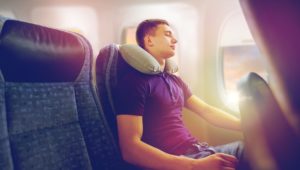
Jet lag gives an example of how drastically changing your daily schedule overnight can bring about negative consequences. When a person travels across several time zones, their circadian rhythms become mismatched with their environment. As a result, they may experience symptoms including trouble sleeping, daytime tiredness, digestive issues, and impaired cognitive ability.
2. Get Outside Early in the Day
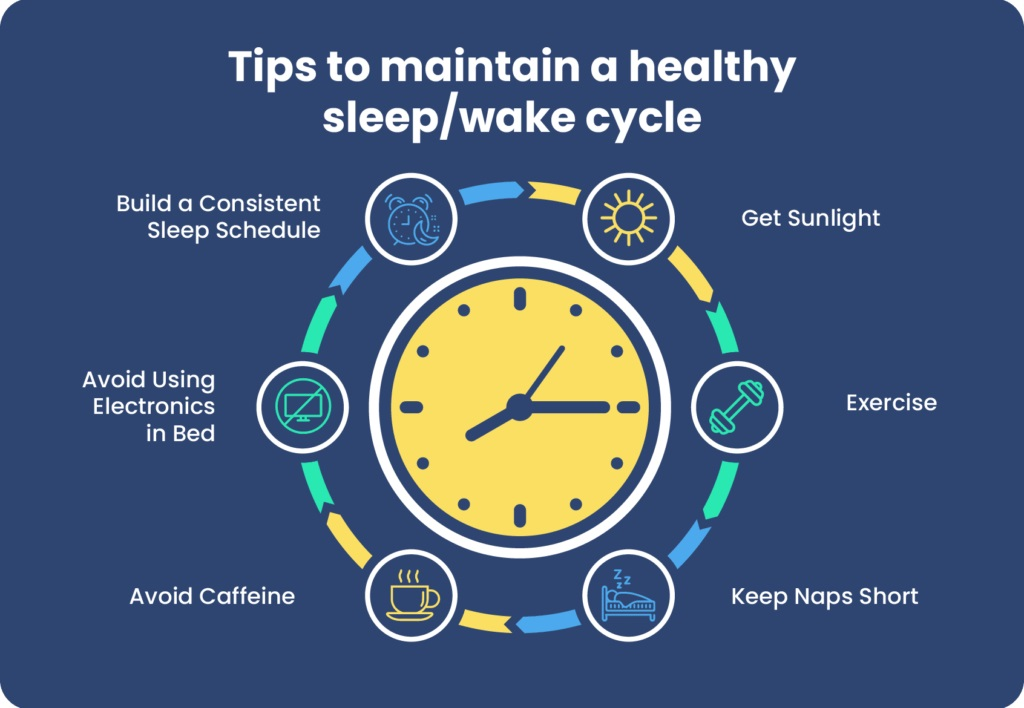
Exposing your eyes to bright light at specific times can help you strategically adjust your circadian rhythms, including your sleep schedule. If you want to wake up earlier in the day, get light exposure in the morning, shortly after you wake up. If you want to stay up later at night, get light exposure in the evening or night, once you’re feeling tired.
Morning sunlight works well to help reset circadian rhythms, since human circadian rhythms evolved in response to living on a planet with daylight and dark nights. If you don’t live in a sunny area or can’t easily access the outdoors, you can also use a bright light therapy lamp for light exposure.
Your best sleep starts with the right mattress.
Our expert testing team tried 300+ mattresses to find the top ones for every sleeping style. See our favorite mattresses of 2026 here.
- In-depth ratings and comparisons
- Regularly updated with new products and testing data
- Options for all types of sleepers

3. Change Your Meal Times
Just like tiredness and sleep schedules, hunger and metabolism are closely linked to circadian rhythms. Research has found that eating meals at later times can shift circadian rhythms later. Similarly, eating breakfast immediately upon waking and avoiding late dinners has been found to help shift circadian rhythms earlier.
If you want to wake up earlier, begin eating earlier. If you want to stay up later, eat later. And as with all circadian rhythm changes, once you’re on the schedule you desire, try to keep it consistent and eat meals at the same time each day.

4. Limit Alcohol and Caffeine
Caffeine may potentially help you feel less tired as you adjust your sleep schedule, but it won’t help adjust underlying circadian rhythms. Caffeine can disrupt sleep, which may cancel out any benefits it provides. Try to limit the amount of caffeine you consume, especially late in the day.
Similarly, people sometimes turn to alcohol to help themselves fall asleep. This isn’t a good strategy. Alcohol can disrupt sleep and amplify the effects of sleep deprivation. Limit alcohol intake and avoid consuming at least one hour before bedtime.
What Throws Off Your Circadian Rhythm?
Anything that impacts circadian rhythms can throw off your master clock and sleep schedule when experienced at the wrong time. These factors include:
- A lack of exposure to sunlight during daylight hours
- Exposure to artificial light, especially blue light, during dark hours
- Eating meals or snacks off-schedule or at inconsistent times
- Going to sleep and waking up at inconsistent times
- Exercise or other physical activity too close to bedtime
- Working the night shift or other forms of shift work
- Traveling across different time zones
5. Reduce Artificial Light Exposure
Since humans evolved to live in synchrony with the daily sunlight schedule, artificial light exposure during outdoor dark hours can disrupt circadian rhythms. Blue light has been found to most strongly impact circadian rhythms. Since digital devices like TVs, smartphones, computers, and tablets emit blue light, it’s best to practice the healthy sleep habit of avoiding these in the hours before bed. Dimming other indoor lights in the hours before sleep may also be useful.
6. Avoid Exercising Too Late
Exercising close to bedtime may disrupt your sleep and throw off your circadian rhythms, especially if you’re a morning person. Exercising regularly promotes healthy sleep, however. If you’re trying to wake up and go to bed earlier, consider exercising in the morning.

Still have questions? Ask our community!
Join our Sleep Care Community — a trusted hub of product specialists, sleep health professionals, and people just like you. Whether you’re searching for the perfect mattress or need expert sleep advice, we’ve got you covered. Get personalized guidance from the experts who know sleep best.
Jay Vera Summer is a writer, editor, and wellness coach. She holds a Bachelor's of Science in psychology and Master's degrees in both writing and public policy.
Dustin Cotliar, MD, holds a medical degree from the State University of NY (SUNY) Downstate College of Medicine, and a master’s in public health from Columbia University, where he focused on healthcare policy and management. He is board-certified in Emergency Medicine, with over eight years of practice that includes emergency medicine, urgent care, and telemedicine.
Learn more about our medical advisory boardReferences4 Sources
Goldstein, C. (February 2024). Jet lag. In R. Benca & A. Eichler (Ed.). UpToDate.
https://www.uptodate.com/contents/jet-lagFacer-Childs, E. R., Middleton, B., Skene, D. J., & Bagshaw, A. P. (2019). Resetting the late timing of ‘night owls’ has a positive impact on mental health and performance. Sleep Medicine, 60, 236–247.
https://pubmed.ncbi.nlm.nih.gov/31202686/Bumgarner, J. R., & Nelson, R. J. (2021). Light at Night and Disrupted Circadian Rhythms Alter Physiology and Behavior. Integrative and comparative biology, 61(3), 1160–1169.
https://pubmed.ncbi.nlm.nih.gov/33787878/Wehrens, S. M. T., Christou, S., Isherwood, C., Middleton, B., Gibbs, M. A., Archer, S. N., Skene, D. J., & Johnston, J. D. (2017). Meal Timing Regulates the Human Circadian System. Current biology : CB, 27(12), 1768–1775.e3.
https://pubmed.ncbi.nlm.nih.gov/28578930/